
Back in 2017, when HeroHomes was a three-man team, we shared a small office with a few other startups. One of them was run by a friend, and he had brought in a teammate from across the causeway who was just finding her footing in Singapore.
Fast forward to 2025 and she reached out again. She had her PR. So did her partner. And they were ready to invest.

"We're thinking of buying one new launch 1-bedroom condo each. It's progressive payment, so we can stretch the mortgage over the construction period. Once they're completed, we'll rent them out, rent a separate place for ourselves, and when we're ready to settle down we'll sell both units to buy a bigger home together."
It was a well-thought-out plan. Logical, structured, and it looked low risk. I went away and pulled the numbers on new launch one-bedders. Then I told them something they were not expecting.
"I don't think this is the best move."
- Across 19 projects bought in 2020, new launch one-bedders in the OCR returned an average of +9.7%.
- Resale two-bedders bought in the same year, same districts, at the same entry prices, returned an average of +35.1%.
- Going prime did not fix it. RCR and CCR new launch one-bedders averaged +5.7%, and one of the three finished down $70,000.
- Even old resale one-bedders beat new launch one-bedders. D17 and D18 resale averaged +25.4%.
Part 1: the illusion of the 1-bedder investment
A lot of people treat the one-bedroom unit as the natural starter investment. Small, cheaper than everything else, easy to rent. You buy early in a new launch, pay progressively through construction, then rent it out on completion. New launch one-bedders now start around $1.2M.
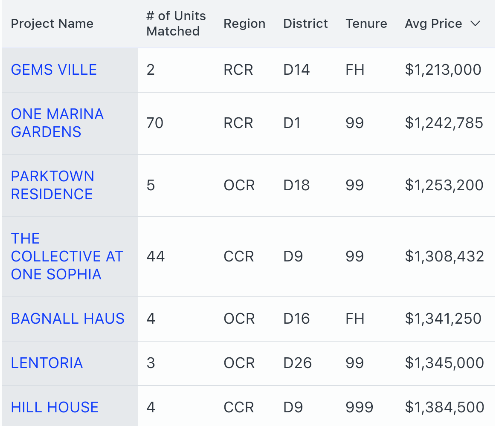
Sounds safe. Here is what that framing leaves out. Most one-bedroom new launches from 2020 to 2024 were already priced with the future profit built into the entry.
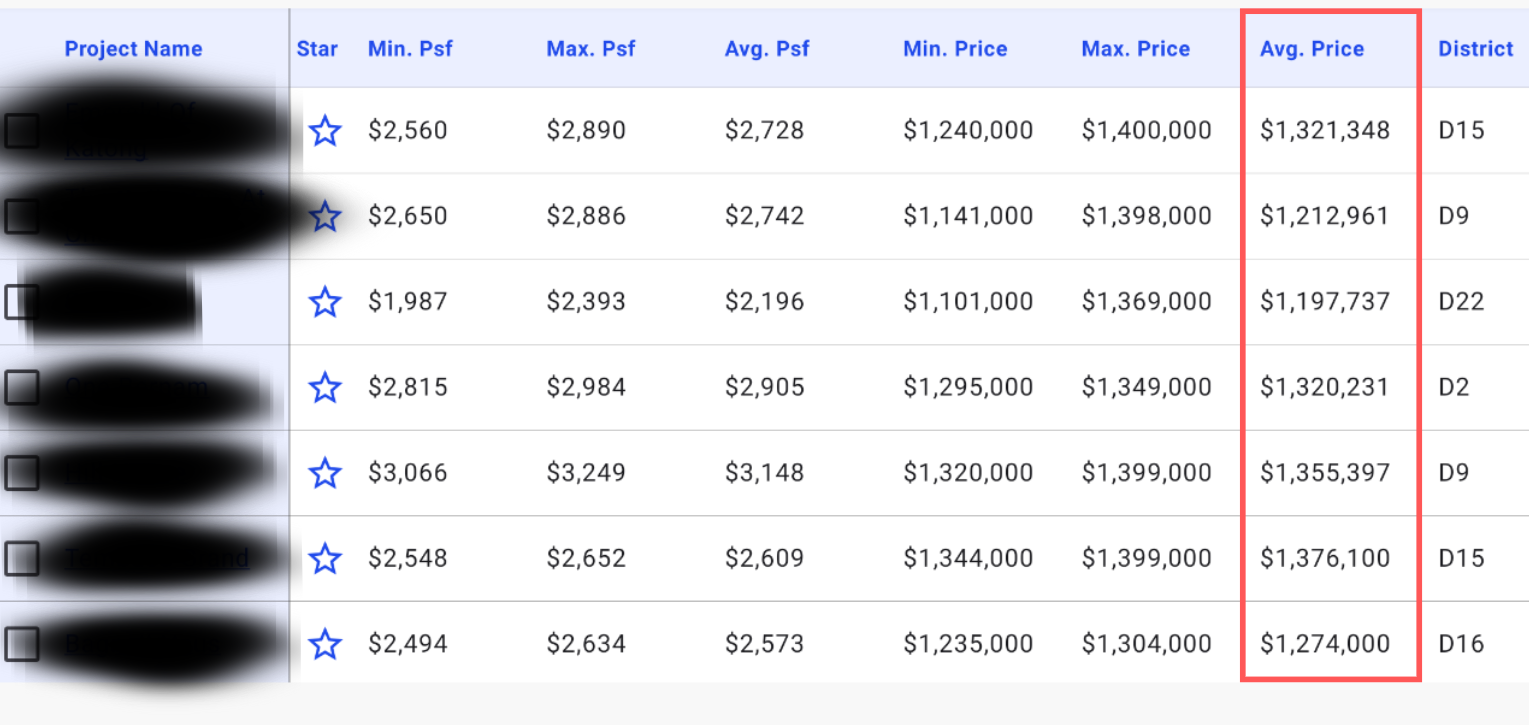
If you are buying now, you are not getting in early. You are providing the exit liquidity for the people who did. Their gain is your entry price. Their profit is your risk.
Part 2: new launch 1-bedder against resale 2-bedder
Rewind to 2020 and look at what buyers actually paid for new launch one-bedders in the OCR, and where those units sit today.
| New launch 1-bedder, OCR | Entry 2020 | Now | Gain | Return |
|---|---|---|---|---|
| The Tapestry | $709,000 | $794,000 | +$85,000 | +12.0% |
| Treasure @ Tampines | $702,000 | $794,000 | +$92,000 | +13.1% |
| The Jovell | $705,000 | $733,000 | +$28,000 | +4.0% |
| Average | +9.7% |
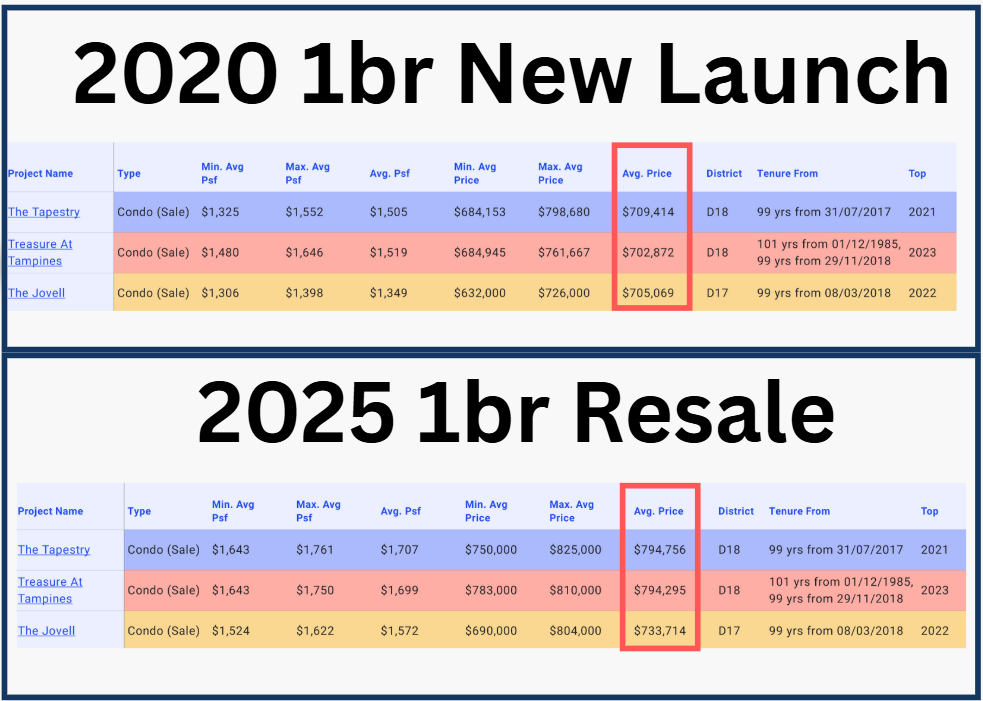
Not bad. Not exciting either. This is what a one-bedder at Treasure at Tampines actually looks like.
Now the same year, the same districts, and roughly the same money, spent on resale two-bedders instead.
| Resale 2-bedder, OCR | Entry 2020 | Now | Gain | Return |
|---|---|---|---|---|
| Melville Park | $681,000 | $889,000 | +$208,000 | +30.5% |
| Ripple Bay | $787,000 | $1,090,000 | +$303,000 | +38.5% |
| Watercolours | $709,000 | $946,000 | +$237,000 | +33.4% |
| Inflora | $731,000 | $1,008,000 | +$277,000 | +37.9% |
| Average | +35.1% |
Entry prices between $681,000 and $787,000, against $702,000 to $709,000 for the one-bedders. This is the same budget.
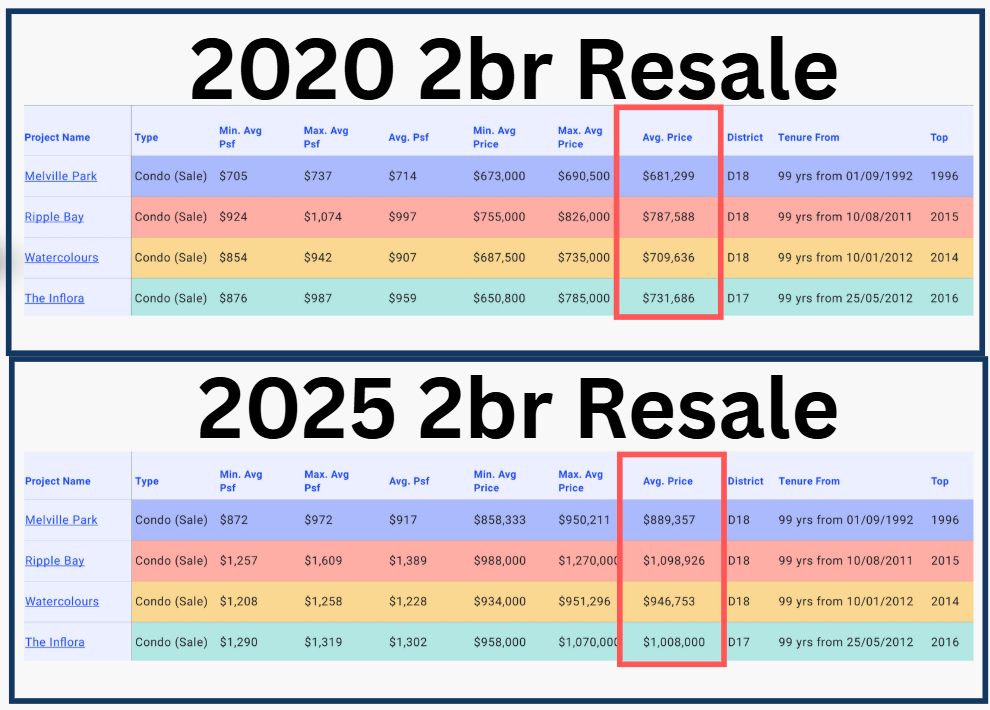
Same budget. Same location. Double the space, and more than three times the return on the money you put in. For a couple willing to rent and wait, that difference is the entire plan. If your exit depends on capital gain, you cannot afford a weak entry.
Part 3: but prime area sure better what
Fair question, and the obvious one. Those were OCR units. What happens in the RCR and CCR? Here are one-bedders bought in 2020 in the Rest of Central and Core Central regions.
| New launch 1-bedder, RCR and CCR | Entry 2020 | Now | Gain | Return |
|---|---|---|---|---|
| Stirling Residences | $999,000 | $1,180,000 | +$181,000 | +18.1% |
| Avenue South Residence | $1,110,000 | $1,160,000 | +$50,000 | +4.5% |
| One Pearl Bank | $1,260,000 | $1,190,000 | -$70,000 | -5.6% |
| Average | +5.7% |
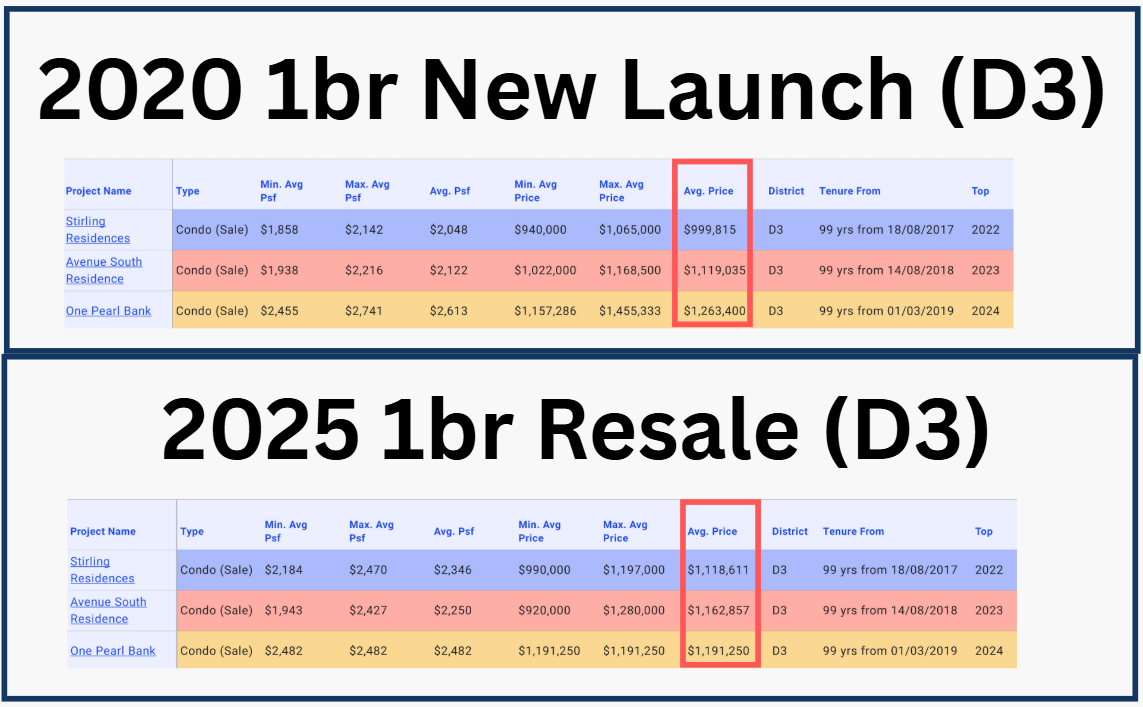
A prime postcode did not protect the entry. One of the three is still underwater five years in. Now the resale two-bedders in the same areas over the same window.
| Resale 2-bedder, RCR and CCR | Entry 2020 | Now | Gain | Return |
|---|---|---|---|---|
| Metropolitan, 2009 | $1,420,000 | $1,680,000 | +$260,000 | +18.3% |
| Emerald Park, 1993 | $1,180,000 | $1,490,000 | +$310,000 | +26.3% |
| Central Green, 1995 | $1,250,000 | $1,450,000 | +$200,000 | +16.0% |
| Average | +20.2% |
Worth being straight about this one: these two-bedders cost more at entry than the one-bedders above, so this is not a like-for-like budget comparison the way Part 2 was. The return column is the fair test, and it still runs 20.2% against 5.7%.
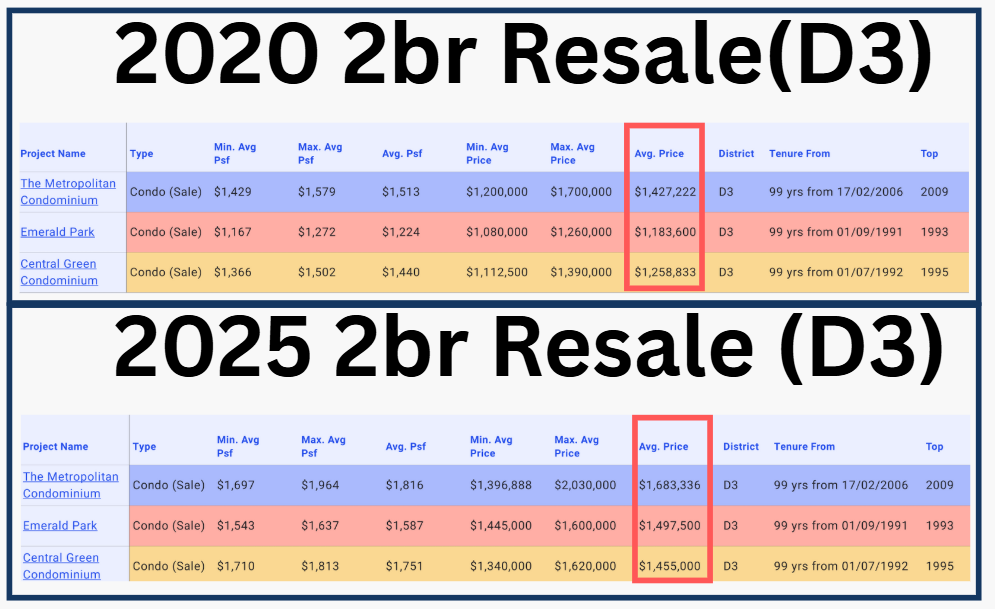
Every one of those older resale units delivered a six-figure gain, without the wait and without the launch premium. This is what a 1993 Emerald Park looks like today.
Part 4: even older 1-bedders did better
The next objection is usually that newer is better, because buyers want modern. So compare new launch one-bedders against old resale one-bedders. Same unit type, different vintage.
| Resale 1-bedder, D3 | Entry 2020 | Now | Gain | Return |
|---|---|---|---|---|
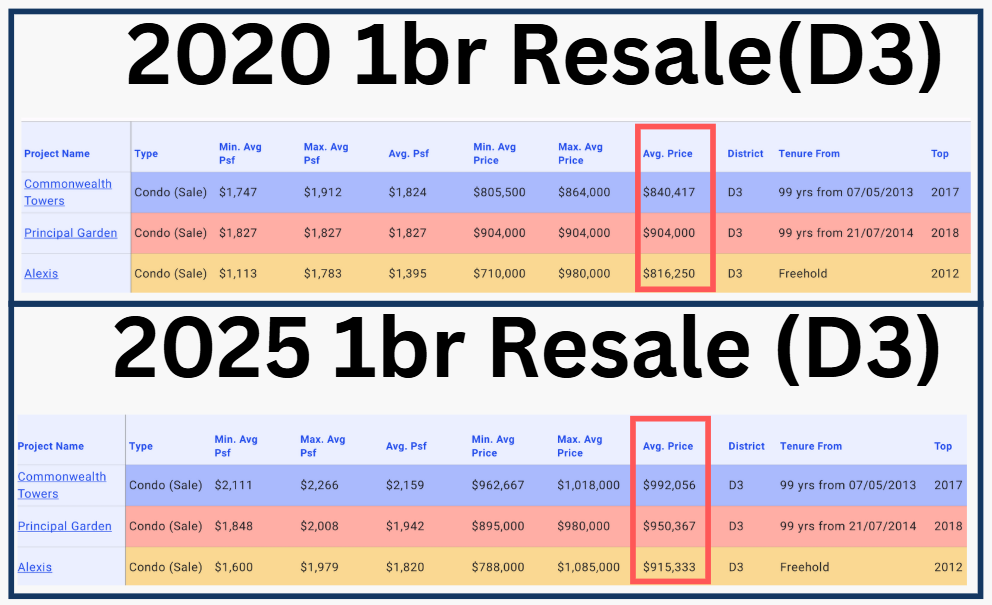
| Commonwealth Towers | $840,000 | $992,000 | +$152,000 | +18.1% |
| Principal Garden | $904,000 | $950,000 | +$46,000 | +5.1% |
| Alexis | $816,000 | $915,000 | +$99,000 | +12.1% |
| Average | +11.8% |
| Resale 1-bedder, D17 and D18 | Entry 2020 | Now | Gain | Return |
|---|---|---|---|---|
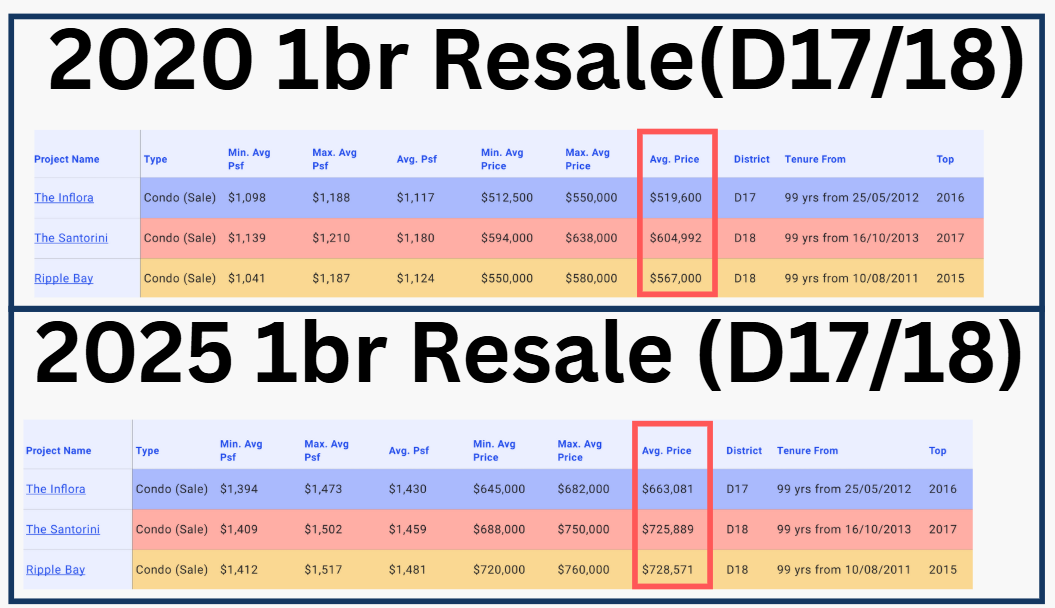
| Inflora | $519,000 | $663,000 | +$144,000 | +27.7% |
| Santorini | $604,000 | $725,000 | +$121,000 | +20.0% |
| Ripple Bay | $567,000 | $728,000 | +$161,000 | +28.4% |
| Average | +25.4% |
Older, less hyped, cheaper at entry, and roughly two and a half times the return of a new launch one-bedder in the OCR.
Why? Because they offered more usable space, they were liveable for an actual owner rather than only a tenant, and they drew end-user buyers rather than investors waiting to flip. Real demand is what makes growth repeatable.
Part 5: the $2.1M one-bedroom
One outlier worth knowing about. The most expensive one-bedder to transact in this period went for $2.1 million, at Nassim Hill. Ordinary layout. Exceptionally prime address.
Emotion, status and postcode made that deal, not arithmetic. Which is fine if that is the market you are in. For most investors, following the feeling instead of the numbers is exactly how you end up stuck when it is time to exit.
What I actually told them
If you are looking at a new launch one-bedder in 2025 on a $1.1M to $1.3M budget, I am not saying it is always wrong. I am saying there are three questions to answer first, and most people answer none of them.
- Is this the best use of the capital? Not is it affordable. Affordable and optimal are different questions, and only one of them shows up in your returns.
- Are you buying for comfort or for clarity? Progressive payment feels gentle. Feeling gentle is not the same as being structurally sound.
- Have you planned the exit before the entry? Who is the buyer in year five to eight, and can they afford your price? If the answer is another investor, you are relying on someone repeating your mistake.
On the same budget you could take a larger resale unit, reach a wider tenant pool, sit on stronger capital appreciation, and exit on your own timing rather than the market's.
And if you are buying a one-bedder to live in rather than to invest, the same data points the same way. Resale is the better hunting ground. More space, better entry price, and still in the locations you want, as long as you know which stacks to look at.
It is not about what you can buy. It is about what is safe for you to buy.
Buying solo, as a couple, or mapping a longer roadmap? Send me the numbers and we will run them properly.
Tell me your situation on WhatsApp ↗I would rather talk you out of a bad entry than help you into one. If the numbers work, I will show you exactly why. If they do not, you will hear that just as clearly. You can also find the shorter versions of this on Instagram.
Client details are shared with permission and identifying information has been withheld. Entry and comparison prices are drawn from transaction caveat data. Entry prices are 2020 transactions, comparison values are as at April 2025. Returns are calculated on entry price and exclude stamp duty, legal fees, interest, agent fees, holding costs and any rental income, so they are not net returns. Project-level figures are representative transactions, not averages of every unit in the development. Past performance is not indicative of future results.
Heikal Shafrudin · Associate Group District Director · PropNex Realty, Singapore · CEA Reg No. R016820G