

Secure Your Future: Unlocking Retirement Income Through Smart Property Investments
Understanding the Urban Redevelopment Authority (URA)’s recent regulations is crucial, as they reshape the property market and create unique opportunities for savvy investors.
This guide will simplify these concepts, illustrate their impact with real-world examples, and provide actionable insights to help you make informed investment decisions.
Key terms to learn
Gross Floor Area (GFA):
GFA is the total usable floor area within a building, measured to the external walls. It includes all floors but excludes non-usable spaces like voids, balconies, and air-con ledges. URA uses GFA to regulate property density and prevent overcrowding in developments.

Net Internal Area (NIA):
NIA represents the actual usable space within a unit, excluding areas like balconies and corridors. This metric is essential for both developers and buyers as it reflects the true living space available.
For now, just ask yourself, why do 90% of HDBs do not come with balconies, but the same is not true for condos?

Plot Ratio:
This ratio compares a building’s total floor area to the land size. An increased plot ratio allows developers to build more space, potentially leading to larger units or more amenities.
Evolution of URA Regulations: A Timeline
In a comprehensive effort to balance property density and living quality, the Urban Redevelopment Authority (URA) implemented significant rule changes over the past decade:
- Pre-2012: No restrictions on unit counts, allowing for higher density developments.
- 2012-2018: Introduction of a 70 sqm per unit division factor, permitting developers to build more units within a given land area.
- October 2018 Update: The division factor was increased from 70 sqm to 85 sqm, effectively reducing the maximum number of units per land area. This shift encouraged the creation of larger, more spacious units, enhancing living environments.
- 2022 Enhancements: Further modifications introduced unit mix controls, mandating:
-
- At least 20% of units must have a net internal area (NIA) of 100 sqm or larger.
- No more than 20% of units can be smaller than 50 sqm.
- At least 20% of units must have a net internal area (NIA) of 100 sqm or larger.
- Post-2023: Changes to bonus GFA allocation, specifically excluding air-con ledges from being counted as bonus GFA.
- Future Speculations: Potential further increases in plot ratios to 95 sqm based on market conditions and government policies.
These changes aim to prevent an oversupply of small, less desirable units, promote balanced and diverse housing options, and improve the overall quality of living environments in new developments.
URA’s New Regulations: Balancing Benefits and Drawbacks
In October 2018, URA increased the average unit size from 70 sqm to 85 sqm. This change means that developers can build fewer but larger units. In 2022, further adjustments were made to regulate the unit mix within developments:
- At least 20% of units must be 100 sqm or larger.
- No more than 20% of units can be smaller than 50 sqm.
Benefits for Home Buyers:
- Higher Quality Units: Larger units with better layouts and amenities are more attractive.
- Reduced Oversupply of Small Units: Say goodbye to shoebox units, ensuring Singapore does not head towards Hong Kong-esque living spaces.
- Enhanced Living Environments: Balanced unit sizes contribute to a more harmonious and livable community.
Drawbacks for Homebuyers:
- Fewer Small Units: Investors who prefer smaller, more affordable units might find fewer opportunities.
- Increased Development Costs: Developers face higher construction costs due to larger unit sizes and enhanced amenities, which can translate to higher property prices.
- Higher Entry Costs: Larger units come with increased Price per Square Foot (PSF), making them more expensive upfront.
Understanding Bonus GFA Utilisation
Developers could include additional spaces like balconies and air-con ledges without them counting towards the total GFA, known as bonus GFA. However, starting in 2023, air-con ledges are no longer excluded from total GFA calculations, impacting pricing strategies by developers.
Strategic Allocation of Bonus GFA:
- Balconies and Open Terraces: Commonly allocated to enhance unit attractiveness but can limit the number of units.
- Communal Facilities: Developments like 8 @ BT & Emerald of Katong allocate bonus GFA to amenities such as function rooms and gyms, enhancing overall living quality and justifying higher PSF.
Impact of 2023 Changes:
- Air-con Ledges: Developers must now include air-con ledges (Typically 7-10% in past projects) in total GFA calculations, potentially reducing the flexibility to use bonus GFA for other amenities or additional balconies.
Real-World Examples: How Developments Are Adapting
Normanton Park:

Launched under the pre-2018 URA regulations with a 70 sqm per unit division factor, Normanton Park comprises 1,840 apartments, 22 strata houses, and 8 shops. With 62.5% of its units being 1-2 bedrooms, it offers a high density of smaller, attractive units for investors.
- Impact of 2018 Rule Change: If Normanton Park had been launched post-2018 under the 85 sqm division factor, the maximum number of units would have been reduced to approximately 1,488 units. This reduction not only limits the investment appeal due to fewer small units but also pushes developers to create larger, more expensive units, potentially increasing prices by 8-10%.
This example underscores how the timing of a development’s launch relative to URA’s regulatory changes can significantly influence unit count, size, and overall investment attractiveness.
8 @ BT
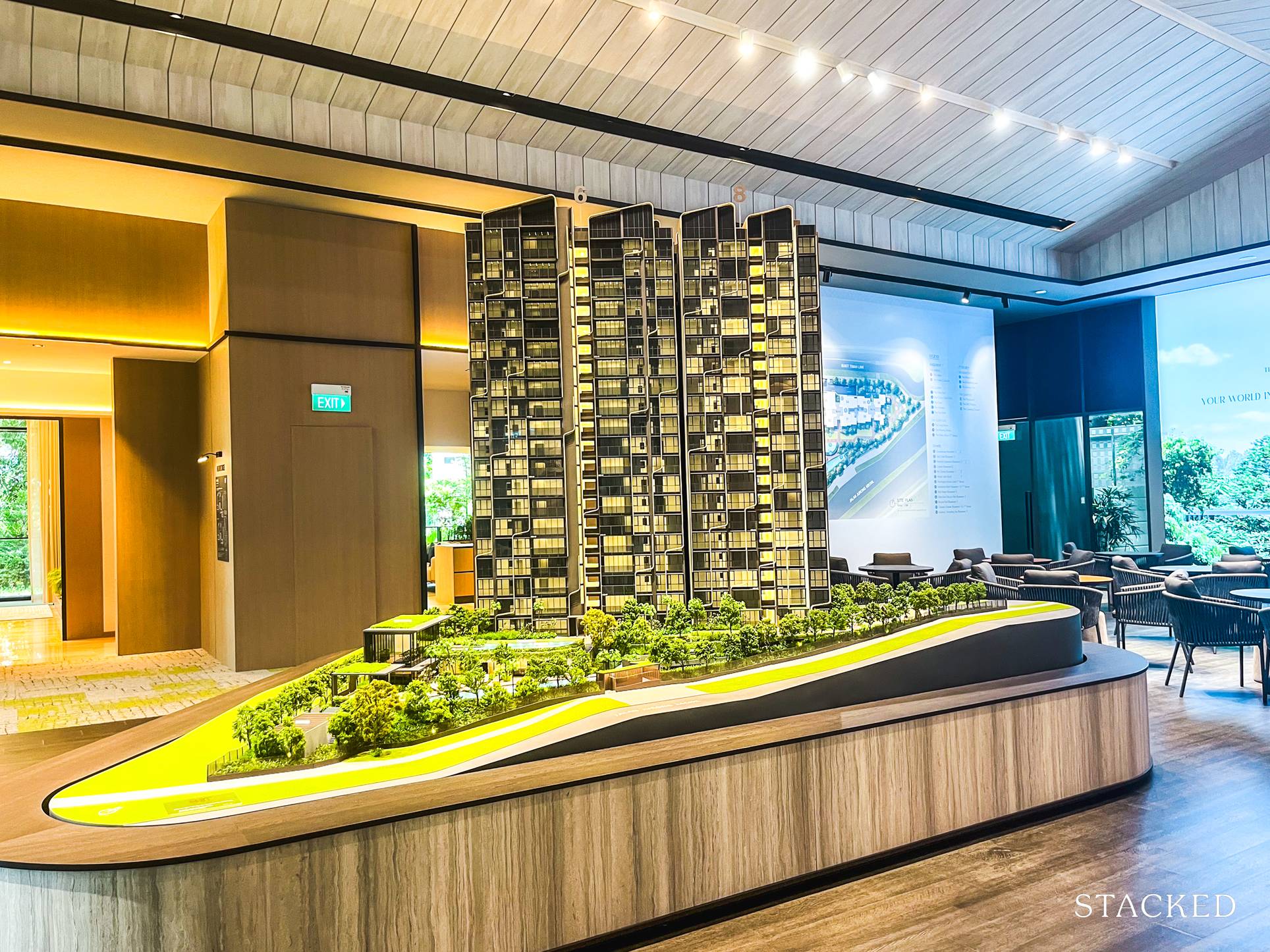
Most of the 3-bedroom units are above 1,000 sqft, and there are 160 units in this project. This development adheres to the 85 sqm plot ratio and 2022 unit mix requirements, offering spacious units with features like large bedrooms and study areas.
Unlike older condos that maximized unit count through balconies, “8 @ BT” enhances common amenities such as function rooms and gyms, improving overall living quality.

However, units here were sold for over $3,000 PSF, compared to typical units in the Beauty World region priced between $2,100-$2,400 PSF.
Terra Hill: Embracing Higher Plot Ratios for Enhanced Living
TeraHill operates under a 100 sqm per unit division, resulting in fewer but significantly larger units. This development emphasizes quality over quantity, offering spacious units with premium finishes.
Impact of 100 sqm Plot Ratio:
- Land Area: 19,365 sqm
- Plot Ratio: 1.4
- Total GFA: 19,365 sqm * 1.4 = 26,151 sqm
- Maximum Units Allowed: 26,151 sqm / 100 sqm ≈ 261 units
Financial and Living Environment Implications:

Higher PSF: Units are priced at a premium (over $2,700 PSF), justified by larger spaces and superior amenities. Nearby older resale can be purchased at just $1,400psf average
Better Living Environment: Larger units provide enhanced comfort, spacious layouts, and high-end features, attracting affluent buyers willing to invest in quality.
Emerald of Katong: A Case Study in Adapting to URA Regulations

The upcoming Emerald of Katong serves as a quintessential example of how developers adapt to evolving URA regulations to optimize both profitability and living quality. Key details include:
- Land Size: 20,572 sqm
- Plot Ratio: 3.5
- Total GFA: 72,003 sqm
Impact of Different URA Regulations:
- Under 70 sqm per Unit (Pre-2018 Regulations):
- Maximum Units: 72,003 sqm / 70 sqm ≈ 1,029 units
- Implications: Higher density with more smaller, affordable units, making it attractive for investors and first-time buyers.
-
Under 85 sqm per Unit (Post-2018 Regulations):
- Maximum Units: 72,003 sqm / 85 sqm ≈ 847 units
- Implications: Reduced unit count with larger sizes, enhancing living quality but increasing prices due to fewer units available.
-
Under 100 sqm per Unit (Current Regulations for Key Locations):
- Maximum Units: 72,003 sqm / 100 sqm ≈ 720 units
- Implications: Significantly fewer but much larger units, targeting a higher-end market segment with premium pricing.
Strategic Adaptations:
Developers of Emerald of Katong strategically optimize unit layouts to comply with the 85 sqm division factor while leveraging bonus GFA to enhance common amenities. This approach ensures
a balanced mix of larger, high-quality units and well-designed communal spaces, appealing to discerning buyers seeking both comfort and a vibrant living environment.
By adjusting to the 2022 unit mix controls, Emerald of Katong ensures that 20% of its units are
≥100 sqm and no more than 20% are <50 sqm, promoting a diverse and harmonious community.

Had this project been developed on the other side of Tanjong Katong, developers would have been forced to follow the 100sqm rulet o better address local infrastructure capacity concerns.
While it would improve the livability aspect of the development, many home buyers would have easily been priced out due to the sheer size of the houses for sale there.
Financial Implications:
The shift to larger unit sizes under higher plot ratios naturally leads to higher Price per Square Foot (PSF). However, the enhanced living environments and premium amenities justify the increased costs, potentially leading to higher rental yields and greater long-term property value appreciation.
Developer Strategies and Market Implications
New Era of Developer Strategies:
Developers are increasingly focusing on appealing to savvy buyers who value livability. By optimizing unit layouts and creatively using bonus GFA for amenities, they enhance property features, strategically increasing functional space and improving living conditions without proportionately raising costs. This approach aligns with URA’s emphasis on sustainable and livable communities.
Market Implications:
- Balanced Unit Mix: Promotes diverse housing options, reducing vacancy rates and ensuring steady rental income.
- Enhanced Property Value: High-quality layouts and premium amenities justify higher property prices, enhancing long-term investment returns.
- Competitive Advantage: Developments that effectively utilize bonus GFA and adhere to unit mix controls stand out in the market, attracting discerning buyers and investors.
Potential Downsides:
- Limited Diversity in Designs: Developers may prioritize efficient, standardized layouts to comply with regulations, potentially limiting creative and unique designs.
- Higher Entry Costs: Larger units with premium amenities often come with higher upfront costs, making them less accessible to some buyers and investors.
The Emotional Side of Investing: Security and Opportunity
Investing in property is not just financial; it’s emotional. Financial security is paramount, as knowing your investments provide a steady income stream during retirement brings peace of mind.
Conversely, the fear of missing out (FOMO) can lead to anxiety about missing lucrative opportunities.
Mitigating Emotions through Knowledge:
Understanding URA’s regulations helps mitigate these emotions by providing clear strategies to maximize your investments while minimizing risks. By aligning your choices with regulatory trends, you can confidently build a property portfolio supporting your long-term financial goals.
Conclusion: Your Path to a Secure and Prosperous Retirement
URA’s new regulations are reshaping Singapore’s property market, presenting both challenges and opportunities for investors. By understanding concepts like GFA Harmonisation and adapting to regulatory changes, you can strategically build a property portfolio that generates reliable retirement income.
As your dedicated realtor, my mission is to help you navigate these complexities with ease. Together, we can identify the best investment opportunities that align with your long-term financial aspirations. Secure your future today by making informed property investments that will support you into your golden years.
Contact me today to start planning your prosperous retirement through smart property investments!