I know how that sounds. Stay with me.
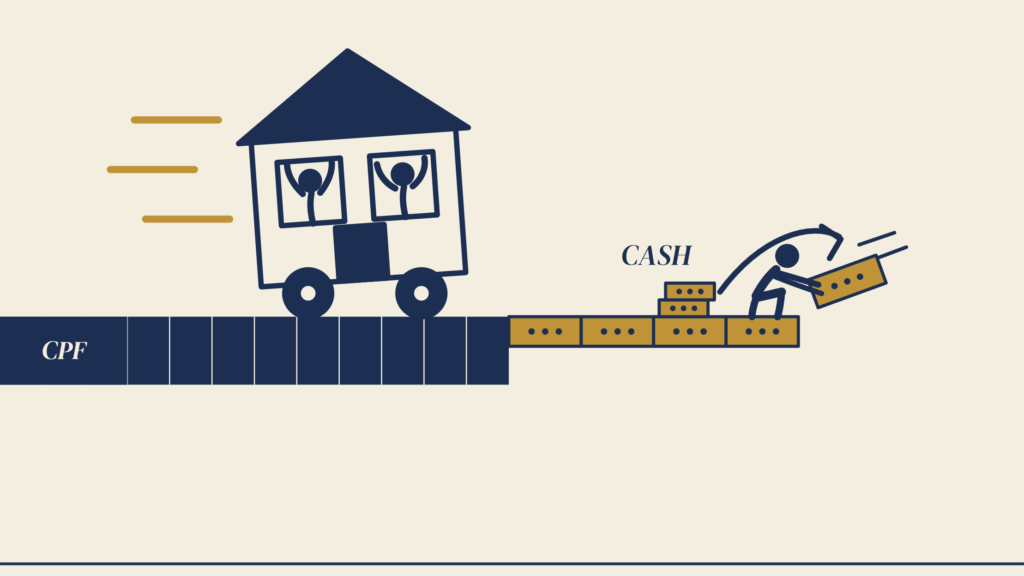
- A smaller loan is not automatically a safer loan.
- On this couple's numbers, borrowing $250,000 more cost about $520 a month in real interest, not the $990 the payment suggests.
- Kept liquid, that same $250,000 covers the mortgage for 4+ years if one income stops. Poured into the downpayment, it covers nothing.
- The deciding question is holding power: how long can you hold, not how low can you borrow.
We have more financial tools than our parents ever had. Better access & education to understanding them than any generation before us. Yet most of us still treat a home loan the way our parents did.
As a threat to shrink as fast as possible.
Here is what I have learned watching hundreds of upgrades. The instinct to take the "safe" loan is often the exact thing that puts the home at risk. Not because debt is good. Because forcing your way to a small loan will cost you the safety net that keeps a roof over your head.
Let me show you a real couple. (I served them in 2022)
They Did Everything "Right"
Both 33. Earning $9,000 each, $18,000 a month between them. Upgrading to a $2.1 million condo.
They were terrified of debt. Their parents had drilled it into them for years: owe the bank as little as possible, a big loan is a noose, clear it fast. So they wanted the smallest loan they could take. They were ready to pour an extra $250,000 of cash & CPF into the downpayment just to shrink it.
It felt safe.
Then I shared the true cost of that small loan.
The Number That Changed Their Mind
They loved the idea of taking $250,000 less loan: it drops their monthly payment by about $990. A real saving.
But once you break down the $990… only around $520 of it was interest. The rest was principal. Money that goes back to them.
So the true cost of borrowing that extra $250,000 was not $990 a month. It was about $520. And here is what that $520 bought them.
| Drain it into the downpayment | Keep it liquid as a buffer | |
|---|---|---|
| The $250,000 | Buried in the bricks | Held in reserve |
| Monthly payment | About $990 lower | About $990 higher |
| True interest cost | ~$520 avoided | ~$520 paid. The other ~$470 is principal that returns to you |
| Cover if income stops | $0 | 4+ years |
The "safe" loan, broken down. Modelled on the couple's 2022 purchase at $2.1M. Verify against your own loan, CPF, and rates before acting. Not financial advice.
That $250,000, kept liquid instead of buried in the downpayment, became their safety net. If one of them lost their income, the working spouse's CPF keeps feeding the mortgage, and that reserve covers the rest of the loan for over four years.
Four years of breathing room. For about $520 a month.
They went quiet. Because once you see it that way, the "safe" loan stops looking safe. You are not saving $990 a month. You are paying $250,000 upfront to lower a number that was mostly your own money, and signing away four years of survival to do it.
The Safety Net Hiding Inside Your CPF
Here is the part almost nobody plans for.
While you are working, your CPF pays a big chunk of your mortgage. It makes the loan feel light. Affordable.
But the day you lose your income, your CPF contributions stop too. No salary, no CPF. The auto-payment you were leaning on disappears at the exact moment you need it most.
That is when a reserve fund stops being idle money and becomes the only thing still standing.
The couple who drains everything into a bigger downpayment has a smaller monthly number and zero cover if things go wrong. The couple who keeps the buffer has a slightly bigger monthly number and years of room to survive a shock without selling in a panic.
Their Parents Were Not Wrong
They were right, for their time.
Higher rates. In the 90s and early 2000s, home loans ran 5 to 7%. Fewer tools, no easy refinancing, less room to recover from a mistake. In that world, avoiding debt was not paranoia. It was math.
What changed is not that the older generation was foolish. It is that the tools changed. Refinancing. CPF flexibility. Longer tenures. And the advice did not update with them.
This couple inherited the fear without the context that made it useful. Most people do.
Today, This Is Even Clearer
When this couple bought, rates were around 2.5%. Today they are closer to 1.55%. Cheaper money changes this in your favour, and most people read it backwards.
Same $2.1 million purchase. Same choice. At today's rates, the actual interest cost of carrying that extra $250,000, the true price of keeping it liquid, drops to about $320 a month. And because your monthly payment is lower and CPF covers more, that same reserve now stretches close to six years instead of four.
The cheaper rates get, the less it costs to hold your buffer, and the longer it lasts. Right now, holding power is close to the cheapest it has ever been. The instinct to empty your account into a bigger downpayment is fighting the one window where keeping it liquid costs you almost nothing.
Read This Before You Decide
So if you have read all this and your takeaway is "great, I'll take the biggest loan and keep nothing in reserve," we seem to be speaking different languages somewhere.
That is not the lesson.
The loan was never the point. The buffer the loan let you keep was the entire point.
So before you pour everything into the biggest downpayment you can manage, stop asking the question everyone asks. Not "how low can I get the mortgage."
Ask the question that actually decides whether you keep the home: how long can I hold when one income stops?
If you do not know your number, that is the dangerous part. Not the loan. The not knowing.
How long could you hold if life changed next year? Run it, then send me your number.
Run the Holding Power Calculator ↗It takes a few minutes. If you want a second pair of eyes on your number, send it to me on WhatsApp. I will tell you what I see.
Heikal Shafrudin · Associate Group District Director · PropNex Realty, Singapore · CEA Reg No. R016820G