
Everybody wants to own two properties without paying ABSD. Nobody asks what it costs to do it legally, or how the process even works. I've just finished my own decoupling, so here are the bills.
IRAS certificate of stamp duty
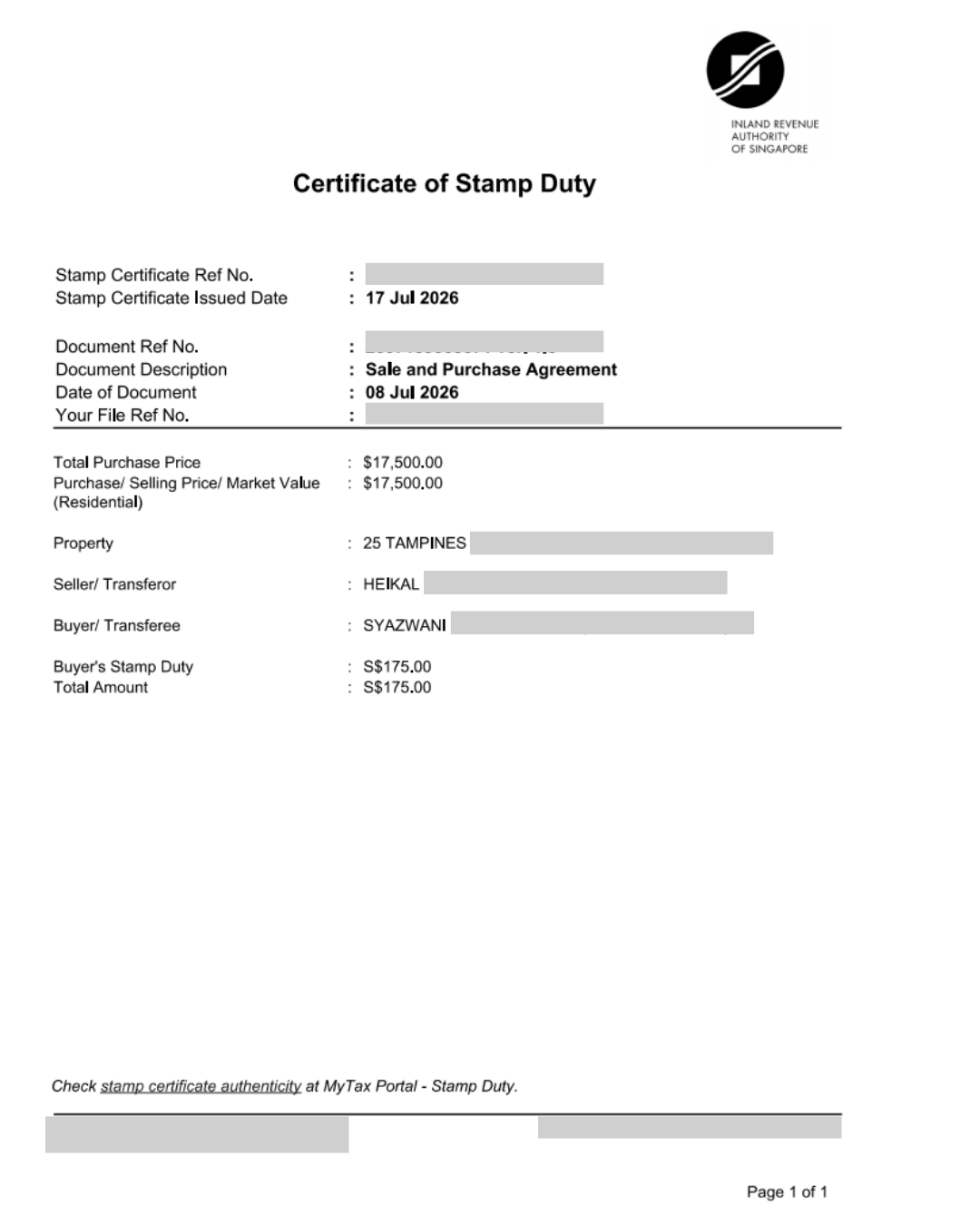
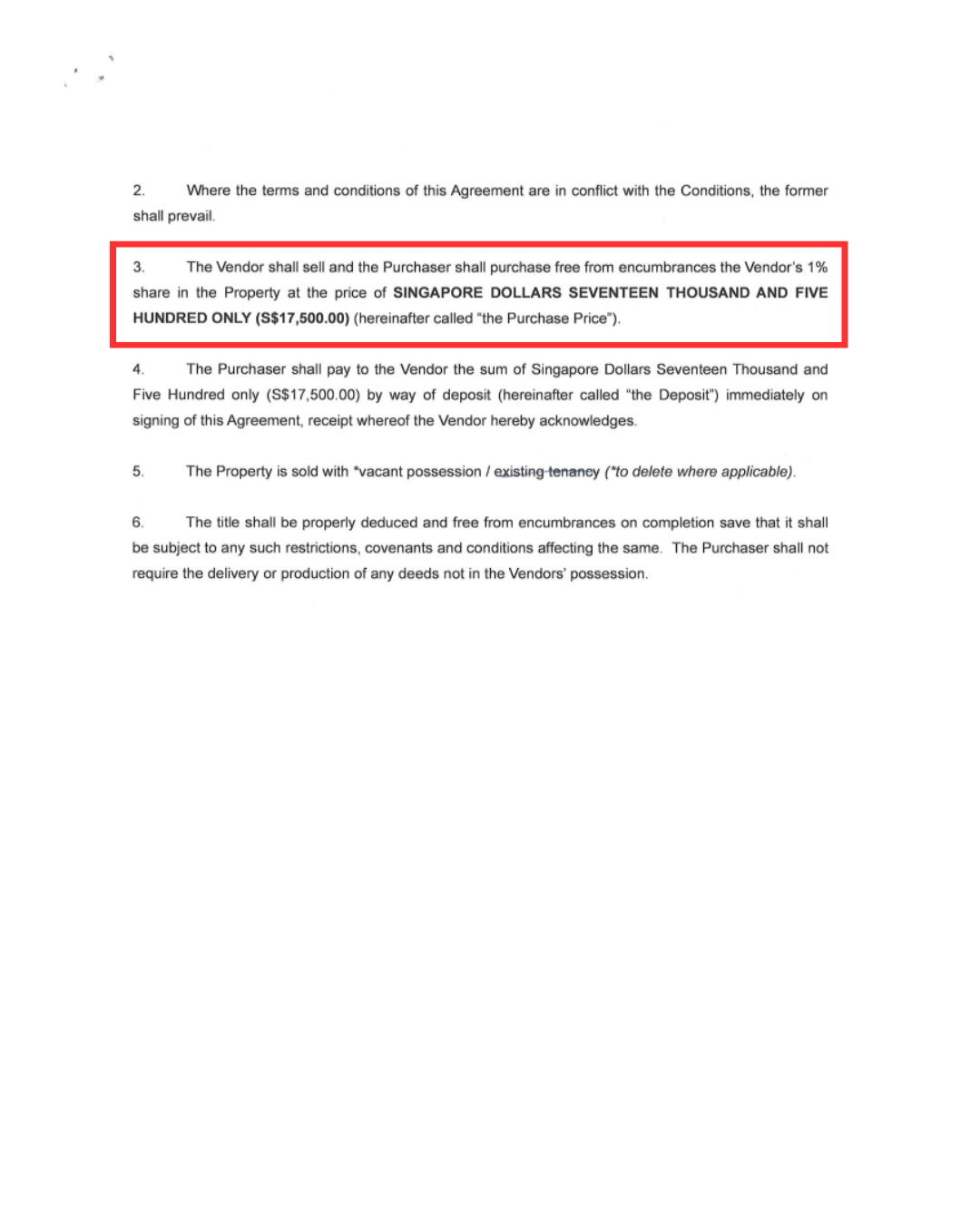
- I sold my 1% share of our condo to my wife for $17,500, which is 1% of the bank's $1.75M valuation. About two months, start to finish.
- Buyer's stamp duty on that $17,500: $175. Legal fees across two firms: $5,000.
- My old bank clawed back the legal subsidy and the valuation fee it paid when I refinanced to them in 2024. That's $2,032.36.
- Total gone for good: $5,622.36.
This is a sale, with a vendor and a purchaser.
When I tell clients to "just decouple," I frame it the short way: one of you buys over the other's share, that person is now homeless on paper, and they're free to buy property number two.
That isn't the full picture. Let me use myself.
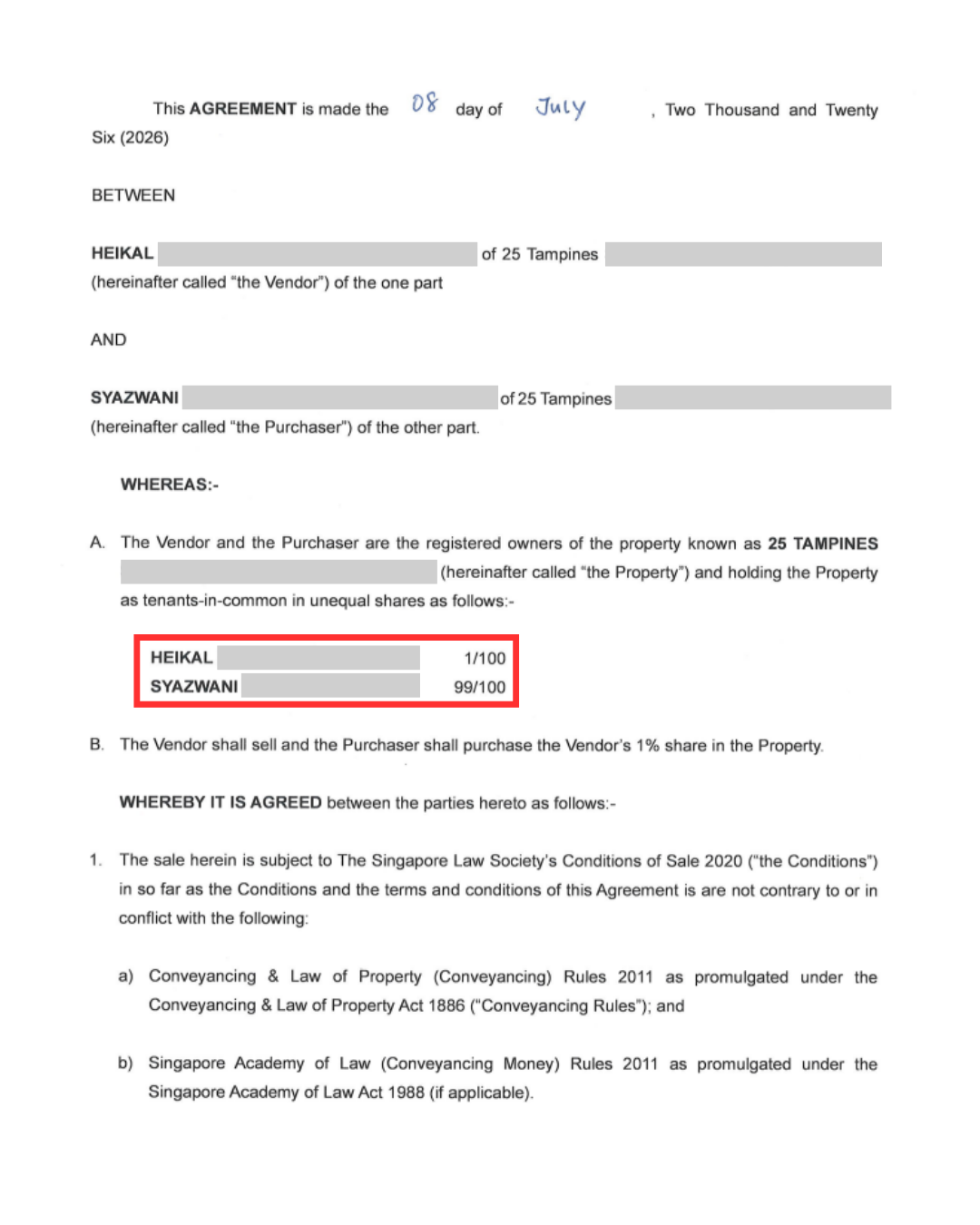
When my wife and I bought our home in 2022, we bought it as tenants-in-common in unequal shares. She owned 99%. One percent sat under my name. If anything had gone wrong, I could only ever have claimed 1% of the value.
That split was my call, and it was my own direction from the start. I set it up in 2022 already planning for a decoupling later, so the share being sold would be small and the money moving between us would be small with it.
Four years later we had the funds and decided it was time. The law firm drafted the sale and purchase agreement, with me as Vendor and my wife as Purchaser.
Then the firm got my wife to physically transfer $17,500 into my account. We screenshotted the PayNow confirmation and submitted it to OCBC for the loan approval. Stamp duty on that $17,500 went to IRAS. $175.
Executed sale and purchase agreement
That's the cheap part, and it's the only part most people have heard of.
What it actually cost.
| Line item | Gone for good | Moved, still ours |
|---|---|---|
| Buyer's stamp duty, to IRAS | $175.00 | $0 |
| My legal fees, as seller | $2,500.00 | $0 |
| My wife's legal fees, as buyer | $2,500.00 | $0 |
| Old bank's legal subsidy, clawed back | $1,707.36 | $0 |
| Old bank's valuation fee, clawed back | $325.00 | $0 |
| New bank's valuation fee | $415.00 | $0 |
| New bank's cash reward | ($2,000.00) | $0 |
| Purchase price, her to me | $0 | $17,500.00 |
| My CPF refund, principal plus accrued interest | $0 | $10,860.87 |
| Total | $5,622.36 | $28,360.87 |
The last two rows were two separate payments. The CPF refund wasn't taken out of the $17,500. Figures from the executed sale and purchase agreement, the IRAS certificate of stamp duty, the outgoing bank's redemption statement, and the incoming bank's letter of offer.
The taxman was cheaper than the lawyers. And there were no agents involved.
One note on that "Gone for good" column. The $5,000 of legal fees didn't come out of cash. Our lawyer messaged to ask whether she should activate our CPF accounts and draw the money from our respective Ordinary Accounts instead. We said yes. The money still went, but it went from CPF, and when you're building a downpayment for the next property, cash is the thing you're short of.
The clawback, and the two penalty periods.
When I refinanced in 2024, Standard Chartered paid my conveyancing fee and my valuation to move the loan across. I'd been with Maybank before that.
That's standard practice. They paid it on the condition that we stayed with them for a set period.
The redemption statement lists it plainly. Legal fees $1,707.36. Valuation $325.00. Both added on top of the loan balance I owed.
Standard Chartered redemption statement
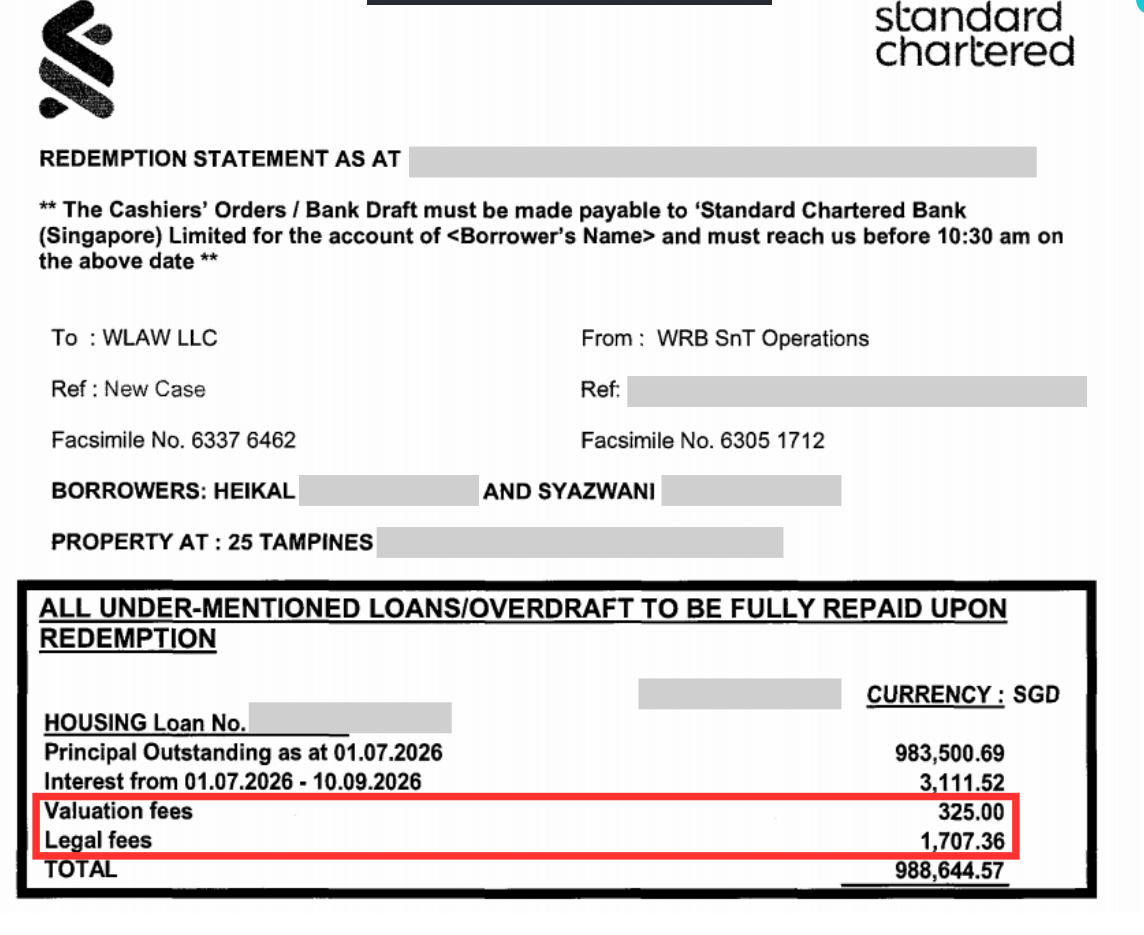
There's a second penalty tied to refinancing, and it isn't on that statement. The early redemption penalty, tied to your lock-in period, usually 1.5% of the outstanding loan. My lock-in from the 2024 refinance had already run out by the time we signed, so it didn't apply. Had it still been running, 1.5% of the $983,500.69 still outstanding would have been about $14,750.
What I hadn't cleared was the three-year clawback on the legal and valuation fees SCB paid for me. I'd overlooked it completely.
The law firm executive caught it. By the time she told me, I was already at her office, pen in hand, ready to sign.
She asked if I wanted to delay six months, clear the clawback period, and avoid the $2,032.36.
"It's okay, Sophia. I've already spent two months dragging out the loan application and the legal paperwork with you before we even met in July. If I delay, I restart everything. The whole loan, the legal process, the conversations with the banker, all from scratch. Six months of redoing work I found annoying the first time. Just to save $2,000, I'd rather spend the money for peace of mind."
Both penalties are avoidable if you read the fine print. I didn't. I still went ahead, because the question wasn't whether I could dodge the fee. It was whether dodging it was worth six months of my life.
And the new bank has one waiting too.
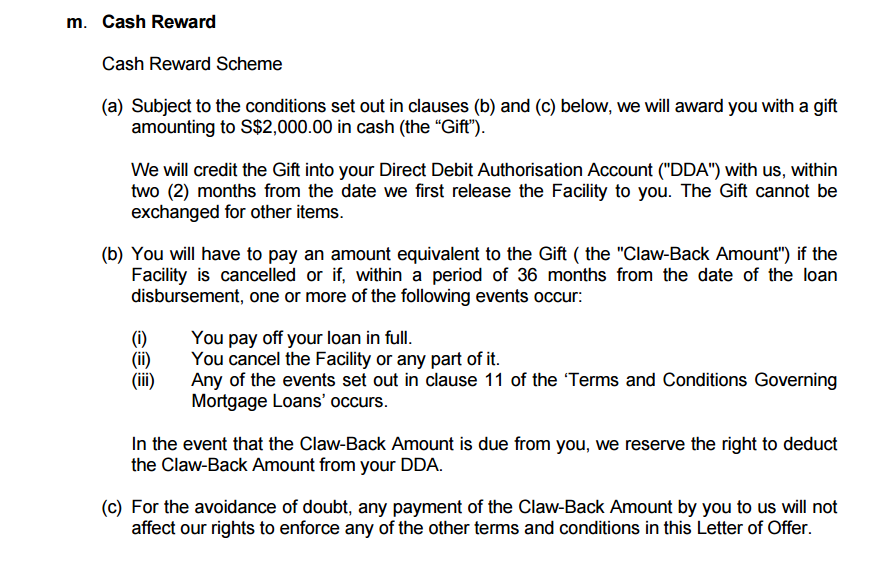
OCBC credits a $2,000 cash reward within two months of releasing the loan. My banker never mentioned it. I found it in the letter of offer, sitting next to its own thirty-six month clawback: redeem or cancel the loan inside three years and I pay it back.
I've locked a three-year fixed rate this time round, so that clause should stay theoretical. It's the same clause I'd just paid $2,032.36 for on the last loan, on a different bank's paper, with a new three-year clock starting the day the money landed.
OCBC letter of offer
The refund tracks what you put in, not what you own.
When you transfer your share, the CPF you used on that property has to go back into your Ordinary Account. Principal plus accrued interest. Mine was $10,860.87, and I prepared a cashier's order for it.
CPF statement
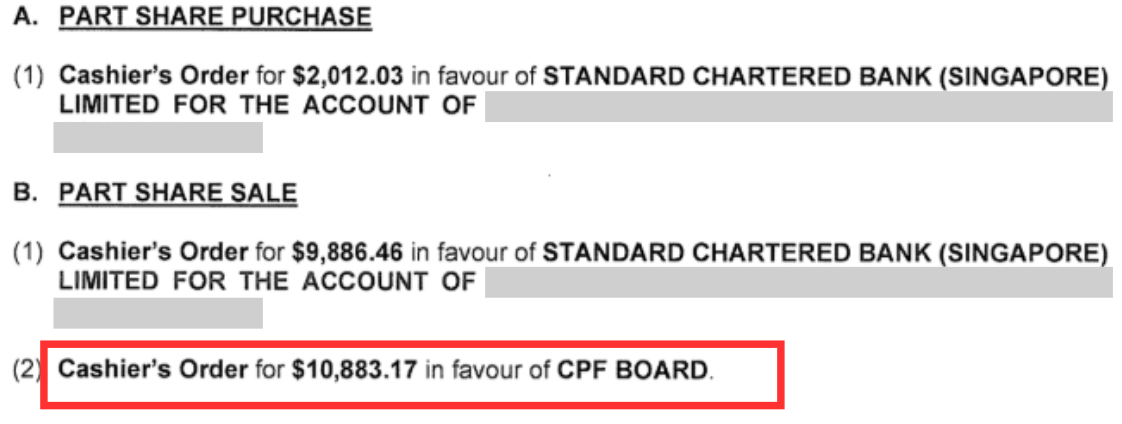
It's a small number, but not because I only held 1%. I've never had much in my Ordinary Account. Mostly NS-related contributions and a bit of part-time work from years ago.
Even if I'd held 50% of that property instead of 1%, the refund would have been the same ten thousand. That's all I ever put in.
Mismatched ownership and CPF ratios
This is the part people get wrong. The percentage on your title and the CPF sitting inside the property are two different numbers, and in most households they don't match. Whoever has been servicing that monthly instalment from their Ordinary Account has been putting money into the home every month, regardless of what share their name holds.
Which is where my own case stops being useful to you.
Picture someone who holds 1% the way I did, but who's been paying the mortgage from their CPF for four years. Say $250,000 of their Ordinary Account is sitting in that home while their name holds one percent of it.
What do they refund when they transfer that 1% out?
It isn't one percent of anything, and this is where it stops being a paperwork exercise. That refund has to be funded by the side of the table that's staying. Whoever buys the 1% is covering the existing mortgage and the departing spouse's CPF refund, out of a larger loan or out of their own pocket, depending on how the numbers land.
Skip the formula. The number is already sitting in your CPF account, under "What Happens If" on your home ownership dashboard. Pull it before anybody drafts anything.
Then take it to a banker and a lawyer who've run a decoupling before, in the same week, and let them work it through together. I got caught by a clause with two months of work already behind me. The refund is a much bigger clause to get caught by.
This is the hoop you cross.
None of it is exciting. Two law firms, a banker, numbers flying around over the phone, a stamp duty certificate, a redemption statement, and a clause I'd forgotten was still running.
The process is boring, and boring is where it gets people. Boring paperwork is where the small print sits, and small print costs you either money or months.
If you want two properties in Singapore, done legally, this is the work involved. Not the shortcut people talk about at dinner. This.
This is my own transaction. Figures are taken from the executed sale and purchase agreement, the IRAS certificate of stamp duty, the outgoing bank's redemption statement, and the incoming bank's letter of offer and fact sheet. CPF accrued interest is the figure stated on my CPF statement. CPF refund rules are as published by CPF Board and current as at September 2026; the computation for a part-share transfer differs from a whole-property sale, so check your own figure directly with CPF Board. The $14,750 early redemption figure is indicative, calculated at 1.5% of the outstanding loan balance shown on the redemption statement, and it was not charged. Costs vary by law firm, bank and individual CPF history. Whether decoupling suits you depends on your own numbers and the rules in force when you transact. Get legal advice before you sign anything. Not legal or financial advice.
