
National Day Rally 2026: the income ceiling change for EC buyers (Part 2)
National Day Rally 2026: the income ceiling change for EC buyers (Part 2)
Heikal Shafrudin · CEA Reg No. R016820G · PropNex Realty · Published 28 September 2026 · Updated 2 October 2026 · 15 min read · Part 2 of 2
The short version.
The EC income ceiling went from $16,000 to $18,000, but not for any EC you can buy today: it applies only to sites tendered from 24 August, starting with Canberra Drive. Those same sites carry May’s tougher rules, so a buyer there realistically gets keys around 2031 and cannot sell until about 2041. On 1 October, the top three bids for Canberra Drive all broke the previous EC land record, so the longer lock-in is not arriving with a discount. Our data on 13,507 EC resales shows that roughly a quarter of every development changes hands in the two years after MOP ends, and that old and young ECs move with the market rather than with age. So the new rules don’t change what your unit is worth. They move the only door out by five years.
The EC change is a 2041 decision
Part 1 looked at the HDB side of the 24 August announcement and found very little: the newly eligible buyer gets about $50,000 of grant and no longer needs cash for the downpayment, and in twelve OCR towns fewer than 3 in 100 large flats sold above the price where any of that starts to matter. Small effect, slow effect.
This side is different. It is the largest change in the whole announcement, and almost nobody led with it.
First, the part that trips everyone up
The $18,000 ceiling doesn’t apply to any EC you can buy today. It covers only sites whose land tender closes on or after 24 August. Nothing on sale now qualifies, and neither do the next launches: Senja Close, Woodlands Drive 17, Sembawang Road and Miltonia Close all stay at $16,000.
The first site under the new rule is Canberra Drive, tender closing 1 October, at about 185 units. That would make it smaller than any EC built in the last 25 years, and one of the smallest ever. That matters more than it sounds. ECs have always been sold as full-facility condos, and 185 units sits closer to boutique condo size: fewer owners sharing the cost of running the estate, and less room for the facilities buyers expect from an EC. What that does to day-to-day ownership deserves its own article, and we’ll cover it separately.
Realistically, the first sales gallery an $18,000 household can walk into opens in late 2027 at the earliest, more likely 2028.
And those sites carry something else.
For a lot of upgraders, an EC has been the natural next step. Condo living, a lower entry price than private, and a clear exit a few years later. That path still exists, but there are now two kinds of EC, and they are very different products.
| ECs on sale today and in the pipeline | New ECs, from Canberra Drive onwards | |
|---|---|---|
| Minimum occupation period | 5 years | 10 years |
| Open to foreign buyers | After 10 years | After 15 years |
| Deferred Payment Scheme | Available | Removed |
| Units set aside for first-timers | 70%, for about the first month | 90%, for the first two years |
| Income ceiling | $16,000 | $18,000 |
The first four rows apply to EC sites whose land tender closed on or after 8 May 2026. The $18,000 ceiling applies to sites whose tender closes on or after 24 August 2026. Canberra Drive is the first site under both. Sources: MND, 8 May and 23 August 2026.
The headlines focused on the bottom row. The rows above it matter far more.
That first-timer row is worth a second look. The 70% set-aside had been the rule since March 2012, and second-timers could usually book whatever was left about a month after launch. From Canberra Drive onwards, it’s 90% of units, held for two full years.
During the 10-year MOP, you can’t sell the unit, can’t rent out the whole unit, and can’t buy another home. Here’s what that looks like for someone buying at Canberra Drive:
- October 2026Land tender closes.
- Late 2027 to 2028Sales launch. You buy, and start paying progressively as it’s built.
- Around 2031You get your keys. The 10-year clock starts.
- Around 2041The earliest you can sell, to Singaporeans and PRs.
- Around 2046Fully private. Anyone can buy.
Launch and completion dates are our estimates, based on typical EC timelines. The rules are fixed; the calendar may shift a year either way.
A buyer who is 35 at launch is around 48 before they can leave. That’s most of a child’s schooling. Possibly a job change or two. Possibly a parent who needs looking after. All of it decided in one signature.
What an EC exit actually looks like
To see what’s really being delayed, we looked at every EC resale we could find: 13,507 transactions across 65 ECs, completed between 1999 and 2020, all in the OCR. For each project, we counted what share of its units changed hands in each year after keys.
| Years after getting keys | Sales that year, per 100 units in the project |
|---|---|
| Years 1 to 4 | under 1 |
| Year 5 | 13 |
| Year 6 | 12 |
| Year 7 | 6 |
| Years 8 to 12, each year | about 5 |
| Years 13 to 15, each year | 2 to 3 |
URA caveat data via Square Foot Research, 65 EC projects, resale transactions only. Median across projects observable at each age. Years 13 to 15 rest on 6 to 10 projects.
For five years, almost nobody sells, because nobody can. Then in years five and six, about a quarter of the whole development changes hands. After that it settles down to roughly 5 sales a year for every 100 units in the project.
The MOP ending isn’t a gentle slope. It’s a door that swings wide open once, and that’s when most owners who were ever going to leave, leave. The new rules move that door from year five to year ten.
Does waiting longer mean a bigger payout?
This is the obvious comeback. If you’re locked in for ten years instead of five, surely you walk out with more?
We tested it. If an EC’s age drove its price, older and younger ECs would grow at different speeds in the same year. So we compared them side by side, within each project, year by year.
| Year | Older ECs completed 1999 to 2008 |
Younger ECs completed 2013 to 2020 |
|---|---|---|
| 2022 | +13.9% | +13.7% |
| 2023 | +10.0% | +9.7% |
| 2024 | +7.1% | +6.2% |
| 2025 | +5.3% | +4.8% |
| 2026, Jan to Aug | +1.8% | +3.1% |
Median year-on-year change in price per square foot, measured within the same project. Same data as above.
They move together. A 25-year-old EC and an 8-year-old EC rose and slowed at almost exactly the same pace. EC prices follow the market, not the calendar on the unit.
Pinevale, one of the oldest ECs in our data, shows what that looks like over a full lifecycle. Its prices have dipped and recovered more than once since launch, and over the long run the line points up. But it points up because the market did, not because the building got older. Owners who sold in a dip got a very different cheque from owners who sold a few years later.
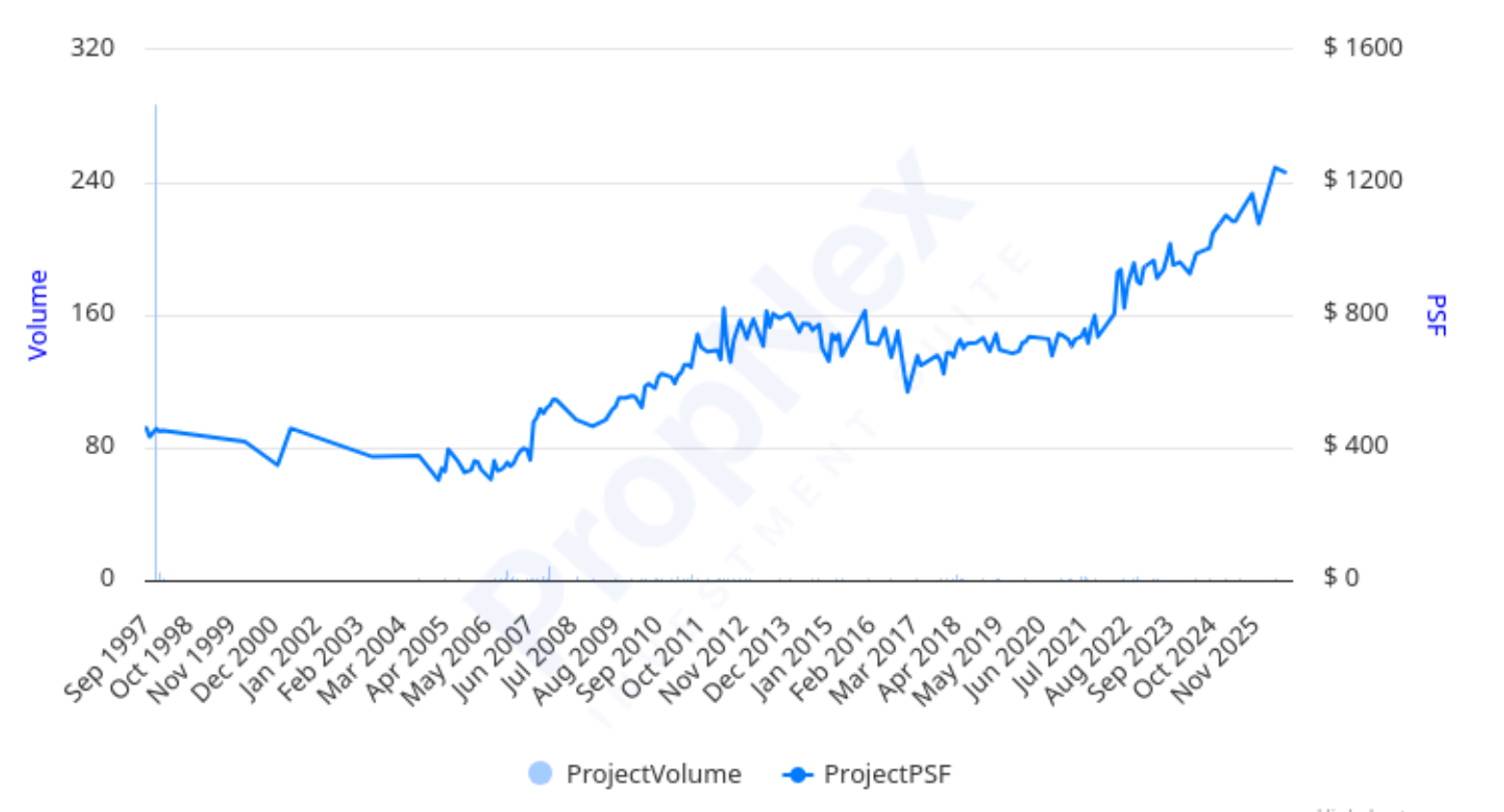
One honest caveat. Those years include a strong run from 2021 to 2024, and none of this predicts where prices go next. What it does tell you is that time in the unit isn’t what makes the money. The market does.
Ten years instead of five doesn’t earn you a bigger price. It means your money stays locked in the walls for another five years.
That is the cost of the new rules, and it is a real one. Not a smaller cheque at the end. Five more years during which you cannot sell, cannot rent the place out, and cannot buy anything else.
What this means if you’re upgrading
Now bring it back to you: selling a flat, looking at an EC.
The new ECs aren’t really built for you. If you bought your flat from HDB or used a grant, you’re most likely a second-timer. For the first two years of a new-rule launch, 90% of units are held for first-timers. Second-timers also pay a resale levy on top of the price.
What losing the Deferred Payment Scheme actually costs
This is the change upgraders will feel first, and it has nothing to do with 2041.
Under the Deferred Payment Scheme, you paid 20% and then nothing at all until the keys were ready, about three years later. You kept paying your flat’s mortgage, and only that one. Without it, you pay 25%, and the EC mortgage starts partway through construction, while you’re still living in your flat and still paying for it.
Here’s the same 3-bedroom unit, roughly 950 sq ft at today’s EC prices, under both.
| A $1.76M 3-bedder | With DPS the five old-rule projects |
Without DPS Canberra Drive onwards |
|---|---|---|
| At booking, in cash | $88,000 | $88,000 |
| Within about 9 weeks, cash or CPF | $264,000 | $264,000 |
| At the foundation stage | nothing | $88,000 |
| Mortgage while it’s being built | none | rises to about $2,760 a month |
| Instalments paid over those 3 years | $0 | about $41,000 |
| Total out before you get the keys | $352,000 | about $481,000 |
| What the scheme costs you | DPS price is 2% to 3% higher: $35,000 to $53,000 | no premium |
Illustrative, at about $1,850 psf, a three-year build and a 25-year loan at 2.5%. Instalments are on the portion of the loan drawn at each construction stage, so they start small and climb. On a 4-bedroom at about $2.31M, every figure is roughly a third larger: $116,000 more at the foundation stage, about $54,000 of instalments, and a mortgage reaching about $3,630 a month. Your own numbers will differ.
So the gap before you get the keys is about $129,000.
But DPS was never free. You paid 2% to 3% more for the unit, which is $35,000 to $53,000 on this one, and you carry it in the loan for 25 years. Net it off and losing DPS costs roughly $75,000 to $95,000 more before handover. What you’re really buying with that money is timing.
One thing that has not changed: an HDB owner buying a new EC still gets the full 75% loan even with a flat loan outstanding, as long as you undertake to sell the flat within six months of getting the keys. So this isn’t about whether the bank will lend. It’s about whether your household can carry two mortgages at once, for three years, before a single dollar of your flat’s sale proceeds arrives.
That’s a holding power question, and it’s the one we’d ask first.
Your exit sits with the HDB market, not the condo market
Here’s the part that’s easy to miss. Nearly 6 in 10 EC resale buyers in our data came from an HDB flat. Your EC buyer is usually someone who has to sell a flat first.
So whether you can exit cleanly depends on how easily HDB flats are selling in the year your MOP ends. Under the old rules, that’s a guess about 2031. Under the new ones, it’s a guess about 2041, in a market where a lot more flats will be well past 40 years old. Nobody can forecast that. What you can do is notice that your exit is tied to it.
The old-rule ECs are still there, for now
Five EC projects were awarded before the 8 May cutoff and haven’t launched yet. All five keep the 5-year MOP, privatisation at 10 years, the Deferred Payment Scheme and the wider second-timer access. All five sit under the $16,000 income ceiling.
| Project site | Developer | Land price | Units | Expected launch price |
|---|---|---|---|---|
| Woodlands Drive 17, parcel 2 | Sim Lian | $794 psf ppr | ~560 | above $1,850 psf |
| Woodlands Drive 17, parcel 1 | CDL | $782 psf ppr | ~420 | $1,800 to $2,000 psf |
| Senja Close, Bukit Panjang | CDL | $771 psf ppr | ~300 | not published |
| Miltonia Close, Yishun | Hoi Hup | $732 psf ppr | ~500 | $1,700 to $1,800 psf |
| Sembawang Road | Oriental Pacific | $692 psf ppr | ~265 | not published |
Land prices are the winning tender bids, per square foot per plot ratio. Launch prices are analysts’ estimates reported at the time of each award, not ours and not the developers’. For reference, Rivelle Tampines launched in 2026 at an average of $1,893 psf and sold about 93% of its units on the opening weekend. The Woodlands and Senja projects are expected to launch from late 2026 into 2027, Miltonia Close in 2027.
Two things stand out. Sembawang Road at $692 psf ppr is the cheapest EC land in almost four years, and the only one of the five bid below $700. And the two Woodlands parcels, each a record EC land price when it was awarded, sit across the road from each other, launching around the same time, with nearly 1,000 units between them. Canberra Drive has since gone higher, as you’ll see below.
There’s also the resale route. ECs that have already cleared their MOP can be bought on the open market by Singaporeans and PRs, with no income ceiling and no balloting. Those are the ones whose door is already open.
Canberra Drive: our read before the result
The tender closed on 1 October, and the bid is the first honest signal of how developers price the new rules against the wider pool of buyers. Old-rule EC sites went for between $692 and $794 per square foot per plot ratio. Here is how we read each outcome, written before the number came in.
| If the bid came in | What it says |
|---|---|
| Below $700 | Developers are discounting the new rules. The 10-year MOP, the loss of the Deferred Payment Scheme and the 90% first-timer hold cost them more than the bigger income pool is worth. Expect the five old-rule projects to launch with confidence. |
| $750 to $800 | In line with the old-rule sites, so the two effects roughly cancel. Developers aren’t paying less for a harder product, which means the cost of the longer lock-in gets passed to buyers rather than absorbed in the land price. |
| Above $800 | A record for EC land. Developers believe the wider buyer pool outweighs everything else. Worth noting that the thing they’d be declining to discount, the 10-year lock, is the thing a buyer should discount most. |
One small site is a thin read, and a low-risk 185-unit plot can attract a punchier bid than its size suggests. For scale: recent analyst estimates of EC launch prices have sat roughly $1,000 to $1,150 per square foot above the land rate. That is a pattern in past estimates, not a forecast.
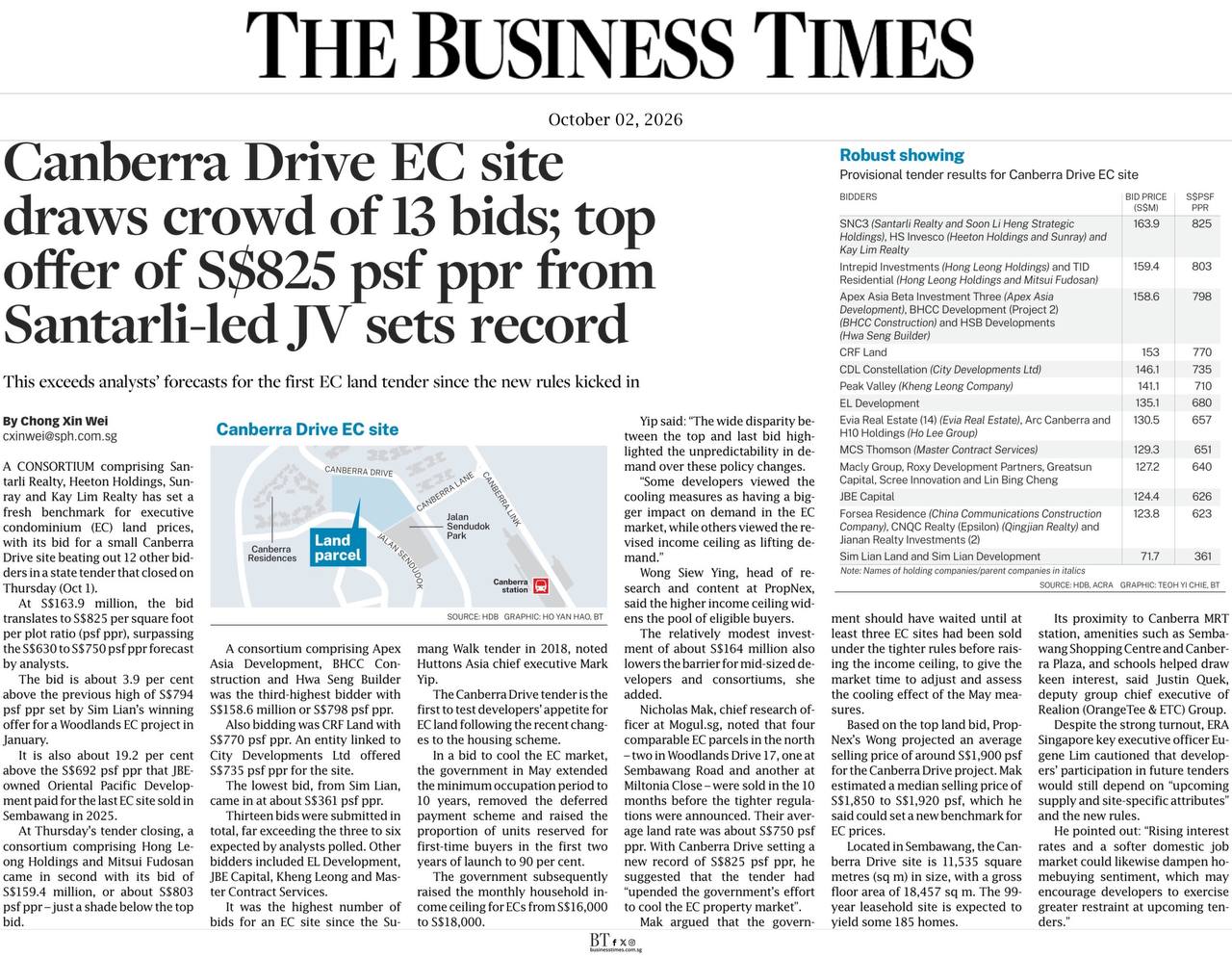
Update, 2 October 2026. The Canberra Drive tender drew 13 bids, the most for an EC site since Sumang Walk in Punggol drew 17. The top bid, from a Santarli-led consortium, was $163.9 million, or $825 psf ppr, well above the $630 to $750 analysts had forecast. HDB’s results are provisional, and the site has not yet been formally awarded.
It wasn’t one bold bidder. The second and third bids, at $803 and $798 psf ppr, also beat the previous EC land record of $794 set at Woodlands Drive 17 in January. Three separate consortiums, within $27 psf of each other, each concluded that buyers will accept the new rules at record prices. That puts the result firmly in our third band. The 10-year lock-in arrives at a record land price, not a lower one, even though the Minister for National Development said in May that he hoped the new rules would lead developers to bid less.
Other condo developers saw it differently. Bids ran all the way down to $361, and seven of the 13 came in below $700, the level we said would mean developers were discounting the new rules. So developers are split on whether buyers will pay for the lock-in. But land goes to the highest bidder, and the launch price gets built on that number, not on the cautious ones.
Early analyst estimates put the eventual selling price at roughly $1,850 to $1,920 psf. At $1,900 psf, the 950 sq ft 3-bedder in our Deferred Payment Scheme table costs about $1.8 million. That’s around $45,000 more than our illustration, with no DPS and a 10-year MOP attached.
Provisional tender results released by HDB on 1 October 2026, as reported by The Business Times, The Straits Times, CNA and EdgeProp. Selling price estimates are from PropNex and Mogul.sg, not HeroHomes.
If an EC is your next step, the question isn’t which one is cheapest. It’s which rules it sits under, and whether your life can fit inside the lock-in that comes with it.
Which is really the point of everything above. Policy changes the rules around a decision. It doesn’t make the decision for you.
Where a policy change fits in the decision
Every time a rule changes, the same question comes up: does this change what I should do? Almost always, the answer is no. A ceiling or an MOP changes the conditions around a purchase. It says nothing about the flat itself, or your cashflow, or who buys it from you later.
The H.O.M.E. Framework
- Holding Power
- Not can you buy it. Can you keep it. If income drops for six months, does the home survive that, or do you?
- Ownership
- What you actually own day to day. Layout, facilities, what you see out the window, the walk to the MRT.
- Market Price
- What comparable units actually transacted at. Not the listing price, not what the policy implies.
- Exit Strategy
- Who buys this from you, when you’re allowed to sell, and can they afford it then?
Run the EC changes through those four and one letter does all the work. Ownership is untouched by the rules themselves: the unit is the same unit, though Canberra Drive’s small size raises Ownership questions of its own. Market Price is barely affected, since our own data shows EC prices follow the market rather than the lifecycle. Holding Power takes a real hit through the loss of the Deferred Payment Scheme, which is the part upgraders feel first. And Exit Strategy moves by five years, which is the single largest change in the whole 24 August announcement.
So: what’s worth watching from here.
What we’re watching
Two things over the next year will tell us how the market is actually pricing the new EC rules.
- 17 December 2026The Admiralty Walk tender. The second EC site under the new rules, at about 450 units and, according to PropNex research, further from an MRT station than Canberra Drive. A small, well-located site can draw a punchy bid. A bigger, less convenient one is a fairer test of whether developers really believe the lock-in costs them nothing.
- Late 2026 into 2027The five old-rule EC launches. How they price, and how fast they sell, is the market putting a number on what a 5-year MOP is worth against a 10-year one. Nothing else will answer that question as directly. Watch Sembawang Road in particular: at $692 psf ppr it is the cheapest EC land in almost four years.
If an EC is on your shortlist and you’re trying to work out whether the lock-in fits your life, that’s a different conversation.
Not a showflat tour. A slow chat about what your flat is likely to fetch, what carrying two mortgages for three years actually looks like, and who buys the place from you at the other end. Numbers over noise.
The ceiling moved. The lock-in doubled. Only one of those changes what an EC is worth to you, and it isn’t the one that made the headlines.
Part 1 covers the HDB side of the same announcement. Heikal Shafrudin, CEA Reg No. R016820G, PropNex Realty. EC figures computed from URA caveat data via Square Foot Research covering 65 EC projects completed between 1999 and 2020. Policy details from MND and HDB releases dated 8 May and 23 August 2026. Land prices are winning tender bids as reported at the time of award. Canberra Drive figures are HDB’s provisional tender results of 1 October 2026. Launch price figures quoted for unlaunched EC projects are estimates made by other market analysts, not forecasts by HeroHomes. Past transaction data describes what has already happened and is not a prediction of future prices. This article is general information, not financial or investment advice, and does not take your personal circumstances into account.