
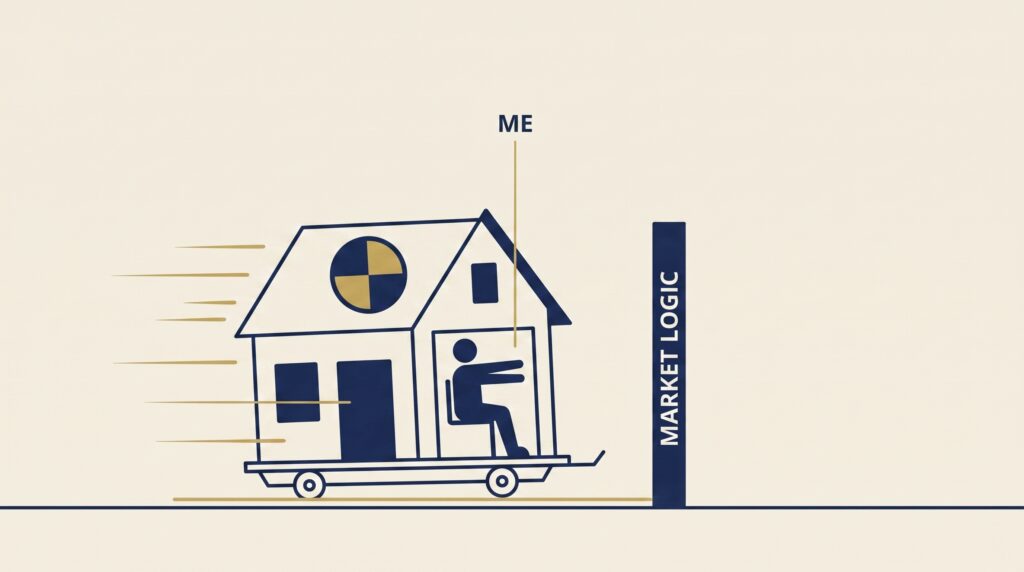
In June 2019 I paid $890,000 for a 98 sqm (1,055 sqft) unit at Belysa, an EC in Pasir Ris. In February 2026, the same unit sold for $1,535,000.
I didn't own it by then. That's exactly why it's the best test I have of how I choose a property.
- The 2019 entry was $844 psf, below every comparable I checked, including same-size units one stack over.
- I sold in 2022 for $1,198,000. The unit resold in February 2026 for $1,535,000, or $1,455 psf.
- From 2019 to 2025 and 2026, median psf for similar-size resales rose 49% at Arc at Tampines, 51% at Waterview, 66% at NV Residences and 67% at Belysa.
- Both buyers after me gave private addresses, not HDB ones.
Near MOP and weighing an upgrade? Jump to the three checks, or WhatsApp me your block and MOP month.
Three checks, in a fixed order
- Exit demand. Who buys this from you, and is that pool proven today and still growing when you'll want to sell. Test: name the buyer before you view the unit.
- Entry below comparables. Are you paying below what the same kind of unit has actually transacted at, nearby and in the same development. Test: price it against caveats, not the listing.
- Holding power. It's a gate, not a score. If you can't carry the loan when one income stops, the first two checks don't matter, because you never get to the exit. Test: carry the loan on one income.
Check one: who buys it from you
In 2019 I wasn't looking at Belysa's showflat, because it didn't have one. I was looking at the Tampines North BTO flats heading towards their five-year MOP.
| Tampines North BTO | Units | Launched |
|---|---|---|
| Tampines GreenRidges | 1,496 | Nov 2014 |
| Tampines GreenWeave | 1,216 | May 2015 |
| Tampines GreenView | 714 | Aug 2016 |
| Tampines GreenVerge | 2,022 | Aug 2016 |
| Total | 5,448 |
Unit counts at launch, per HDB launch records. MOP timing is indicative and depends on each project's actual completion date.
That's roughly 5,400 households becoming eligible to sell and move up between about 2024 and 2026. In 2019, that wave was five to seven years away.
Belysa itself was at a turning point. It had just reached its own MOP, so 2019 was its first open resale window. Around 2024 it would pass ten years from completion and become fully private, which widens who's allowed to buy it.
Supply on one side, a widening buyer pool on the other. That was the exit case, before I'd looked at a single unit.
What we walked away from
We looked at Arc at Tampines first. It was compact and dense. Most of the units we viewed faced another HDB block, or straight into a neighbour's unit.
We looked at Pinevale. It felt dated to us. At about 1,300 sqft it was also more flat than two people needed for a first home, with a renovation bill to match.
Neither was a bad development. They were the wrong units for us, at those prices.
The case against Pinevale was never price. It was fit: more space than we needed, a renovation budget we didn't want, and a place that felt tired on the day we saw it.
Arc is the one where the viewing and the numbers agree. The layout put us off, and in the size-matched comparison below it grew least of the four.
Check two: entry below comparables
A good development at the wrong price is still a bad entry. So the question wasn't whether Belysa was good. It was whether this unit was cheap against units like it.
| Belysa | Arc at Tampines | NV Residences | Waterview | |
|---|---|---|---|---|
| 2019 median psf | $857 | $942 | $872 | $1,044 |
| 2019 median price | $950,000 | $1,064,450 | $1,070,000 | $1,190,000 |
| Sep 2025 to Aug 2026 median psf | $1,432 | $1,406 | $1,448 | $1,580 |
| Change | +67% | +49% | +66% | +51% |
Resale transactions, 1,000 to 1,250 sqft. NV Residences had five such resales in 2019. Medians mix floors and stacks. Source: URA caveats via Square Foot Research.
My unit went in at $844 psf. That was below all four medians, including Belysa's own.
It was also below its direct neighbours. Same-size units one stack over sold at $891 to $920 psf in 2019.
| Belysa, 1,055 sqft | 2019 | 2025 to 2026 |
|---|---|---|
| My stack | $844 psf | $1,455 psf |
| The next stack over | $891 to $920 psf | $1,422 to $1,517 psf |
Individual resale transactions. Source: URA caveats via Square Foot Research.
Same size, same development, same year. The cheaper stack went in about $50 to $75 psf lower and came out inside the same range.
Profit is determined at purchase, not at sale.
Check three: could you carry it on one income?
This is the check that decides whether the other two ever matter. A unit can pass on exit demand and entry price and still fail you, if the loan only works while both of you are earning.

The bank's TDSR cap of 55% tells you what you're allowed to borrow. It doesn't tell you what's safe to carry.
So the test runs the other way. Take the monthly instalment at a stress-tested rate, not today's rate. Then ask whether the lower of your two incomes, plus your cash and CPF buffer, could carry it if the other income stopped.
Most buyers do this in the wrong order. They find the unit, get the maximum approval, and only then ask whether they can live with the payment. By then the decision has already been made at the showflat.
If you can't hold it, you never get to the exit.
Before you shortlist a single unit, find out how long you could hold one.
Run the Holding Power Calculator ↗Where this framework can fail
The exit buyer isn't who it used to be. Across the 95 or so suburban condos and ECs in our transaction set, buyers giving an HDB address fell from about 61% of resales in 2020 and 2021 to 42% in 2026. Both buyers of my old unit after me gave private addresses.
Upgraders are still a large group. They're just no longer the majority, so an exit case built only on them is thinner than it looks.
The Straits Times put the same risk in policy terms in June 2026. If the next wave of HDB upgraders finds an EC harder to finance, the buyer pool my exit case rested on gets thinner still.
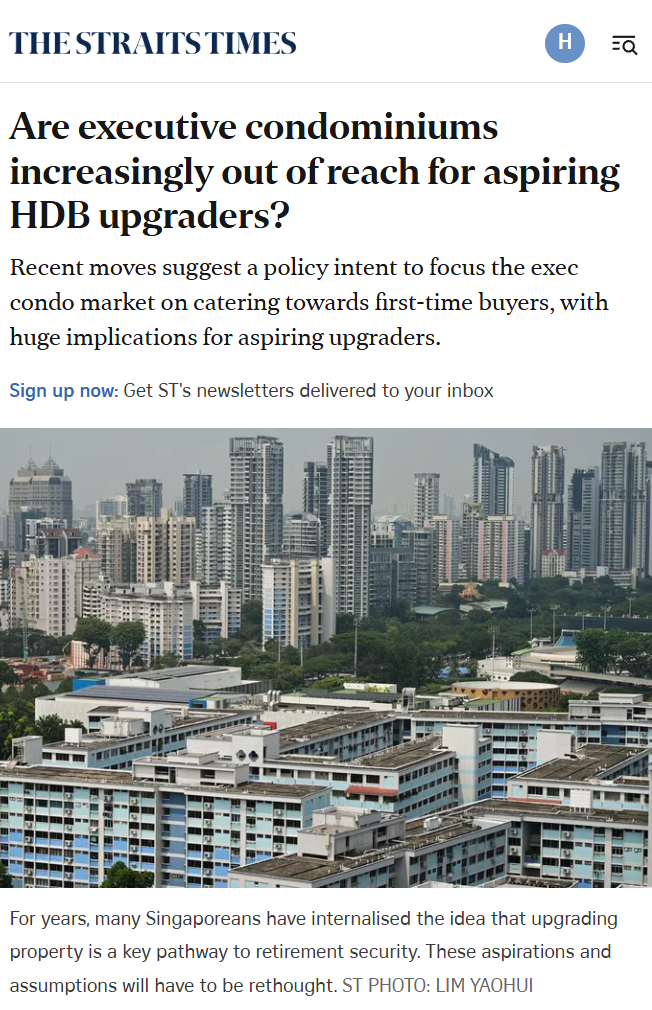
"The policy changes mean that HDB upgraders will face more difficulty financing an executive condo."
The Tampines wave also has an end date. Tampines BTO launches ran above 2,000 units in most years from 2016 to 2021, then dropped to 267 in 2022, none in 2023, 561 in 2024 and 380 in 2025. Anyone buying today with a five-year exit sells into the tail of that wave, not the peak.
Older developments carry one more risk. When the remaining lease can't cover a buyer to age 95, the CPF they're allowed to use is pro-rated down. That shrinks the pool of people who can afford to buy from you, and it gets tighter every year you hold.
The unit kept proving the selection
In 2026 the unit came back on the market. I was a co-broke agent then, bringing my own buyers through a flat I used to live in.
My buyers didn't offer the price it closed at. Someone else did: $1,535,000.
$1,455 psf, on a unit bought at $844.
Want these three checks run on your flat?
Pick the one that fits where you are.
Send my block and MOP month ↗
Send me the listing ↗
All transaction prices are from URA caveats, accessed via Square Foot Research. Comparable figures are median psf for resale transactions in the size bands stated under each table and are not formal valuations. BTO unit counts are as launched by HDB; MOP timing is indicative and depends on actual completion dates. Buyer-address shares are drawn from caveats across the projects in our dataset and are not a national figure. Views on other developments reflect the author's own viewings in 2019. The author represented prospective buyers in the 2026 resale who did not purchase the unit. This is the author's own purchase; no names have been changed. Past performance is not indicative of future results.
Heikal Shafrudin · Associate Group District Director · PropNex Realty, Singapore · CEA Reg No. R016820G