
The 60-second version of a decision most couples overthink. The full answer is in the summary below. Everything after it is optional depth. Read only what you need.
Read this, skip the rest if you like. How you hold your home is a decision, not paperwork. Pick your goal.
- One home, survivor fully protected: Joint Tenancy. Done.
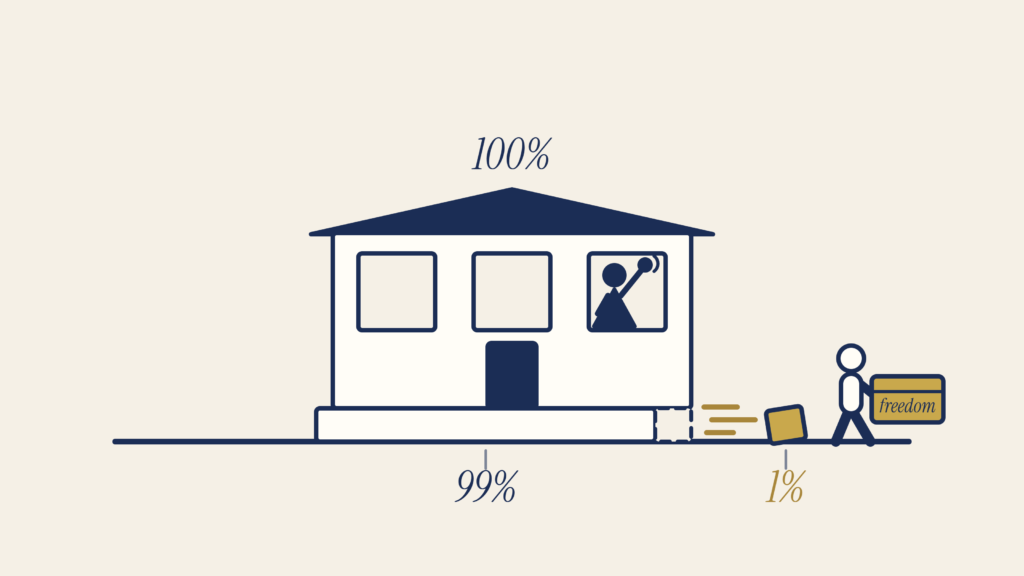
- Keep this home and buy a second later without the 20% ABSD: Tenancy-in-common, 99:1.
- Equal owners, siblings, or co-investors who each want to leave their share to their own beneficiaries: Tenancy-in-common, 50:50.
Going the 99:1 route? It only works if all three are true:
- Each of you can carry a home loan on one income alone. This is the real test, not the joint one you qualified on.
- The second property is worth enough (around $1.5M and up) to beat the cost of splitting.
- Duty is paid at every step and a lawyer signs off. 99:1 audits the shortcuts.
Decoupling takes roughly 10 to 12 weeks and a few thousand in fees. Done right, it saves the 20% ABSD on your next home. Get any of the three wrong and it can quietly cost you more than it saves.
How decoupling works in a 99:1 structure.
Here is what actually happens, step by step, when a couple decouples a home held 99:1.
- The starting point. A home worth $1,750,000, held 99:1. The wife owns 99%, the husband owns 1%.
- The transfer. The husband sells his 1% to the wife for $17,500. She becomes the sole owner. She pays Buyer's Stamp Duty on the $17,500 only, no ABSD, because she still owns just this one home.
- The new loan. She refinances the whole property to a new bank loan, in her name alone.
- The old loan steps out. The existing bank loan is discharged. The new bank registers and holds the title.
- CPF and declarations. CPF is moved to her sole name. They sign the related-party declaration, since they are married.
- The catch. Before accepting the new bank's letter of offer, confirm the existing bank's exact payout figure, penalty included. Miss this detail and the whole timeline slips.
- Timeline. Total 10 to 12 weeks of processing, start to finish.
Not sure whether 99:1 actually saves you money, or just costs you more? That's the exact question to test first.
Get a Second Opinion ↗Which structure fits you.
| Joint Tenancy | TIC 50:50 | TIC 99:1 | |
|---|---|---|---|
| Best for | One home, survivor protected | Equal owners or co-investors, each leaving their share to their own beneficiaries | Keep this home, buy a second later |
| On death | Survivor gets 100%, automatic | Follows the will. No will is a trap. | Follows the will. No will is a trap. |
| Cost to decouple later | High. Must convert first. | High. 50% share moves. | Low. Only 1% moves. |
What buying one spouse out actually costs.
Same home, same goal, three structures. A $1,750,000 home with $590,000 of loan and $300,000 of CPF inside. One spouse is bought out so the other owns 100%, freeing the first to buy again without the 20% ABSD.
| TIC 99:1 | TIC 50:50 | Joint Tenancy | |
|---|---|---|---|
| Extra step first | None | None | Sever the JT first |
| Share transferred | 1% | 50% | 50% |
| Value of their share | $17,500 | $875,000 | $875,000 |
| Buyer's Stamp Duty | $175 | $20,850 | $20,850 |
Figures illustrative, for the modelled home above. Verify against your own valuation, loan, and CPF before acting. Not legal or financial advice.
The structure is not the point. The point is which one keeps your next move cheap and your family protected. If you are not sure which of these you are, that is exactly the conversation to have before you sign anything.
