
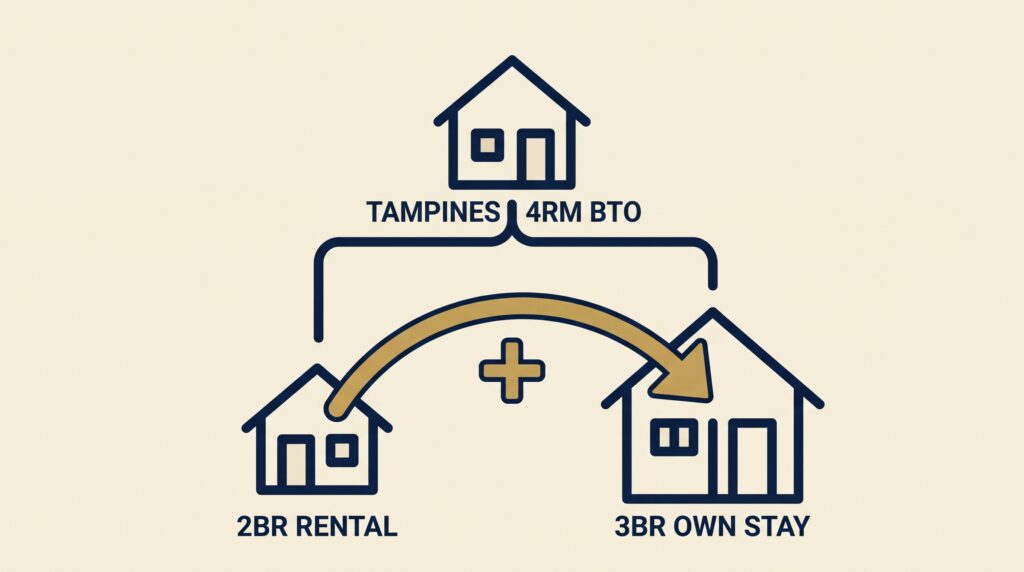
We helped a Tampines 4-room BTO owner end up with two properties worth $2,435,000 and over $77,000 still in the bank. No extra money went in.
BTO owners reaching their Minimum Occupation Period are usually presented with two choices:
1) Stay in it, or
2) Sell and buy bigger.
A 3rd option that's rarely given much thought exists, and it's usually avoided once you realise how crazy the IRAS taxes and stamp duties involved will be.
But if you spend time to go through the hoops, and you're willing to take some sacrifices, you and your spouse can still own 2 properties instead of one. One you live in, the other collecting rental every month for you.
So this is how we helped one of our past clients. Names and addresses tweaked slightly, but the figures are exactly as they happened.
About this series.
An ongoing series on how a household legally holds two properties without paying ABSD. One property per name, so neither purchase is a second property. Live in one, rent out the other, and let that rent carry the position. Case studies and concepts, built from real clients and public data.
The short version.
- They sold a Tampines 4-room BTO for $780,000 and walked away with $342,796 in cash and $374,200 of CPF refunds.
- They bought two properties instead of one, $885,000 and $1,550,000, one in each name.
- $265,650 of the HDB cash proceeds went into deposits. $77,146 was set aside for expenses and savings.
- The rent from the smaller property covers the shortfall on the larger one.
The case.
| Journey | Tampines 4-room BTO, jointly held, to two separately held private properties |
| Structure | Sell 1, Buy 2. One property per name. |
| Timeline | Sold 2024, both purchases 2024, refinanced in 2026 |
| Result | Rental and CPF income supporting 2 properties with almost zero monthly cash outlay |
Which property wasn't the decision. It was figuring out who owns the rental, and who owns the property they live in.
The before.
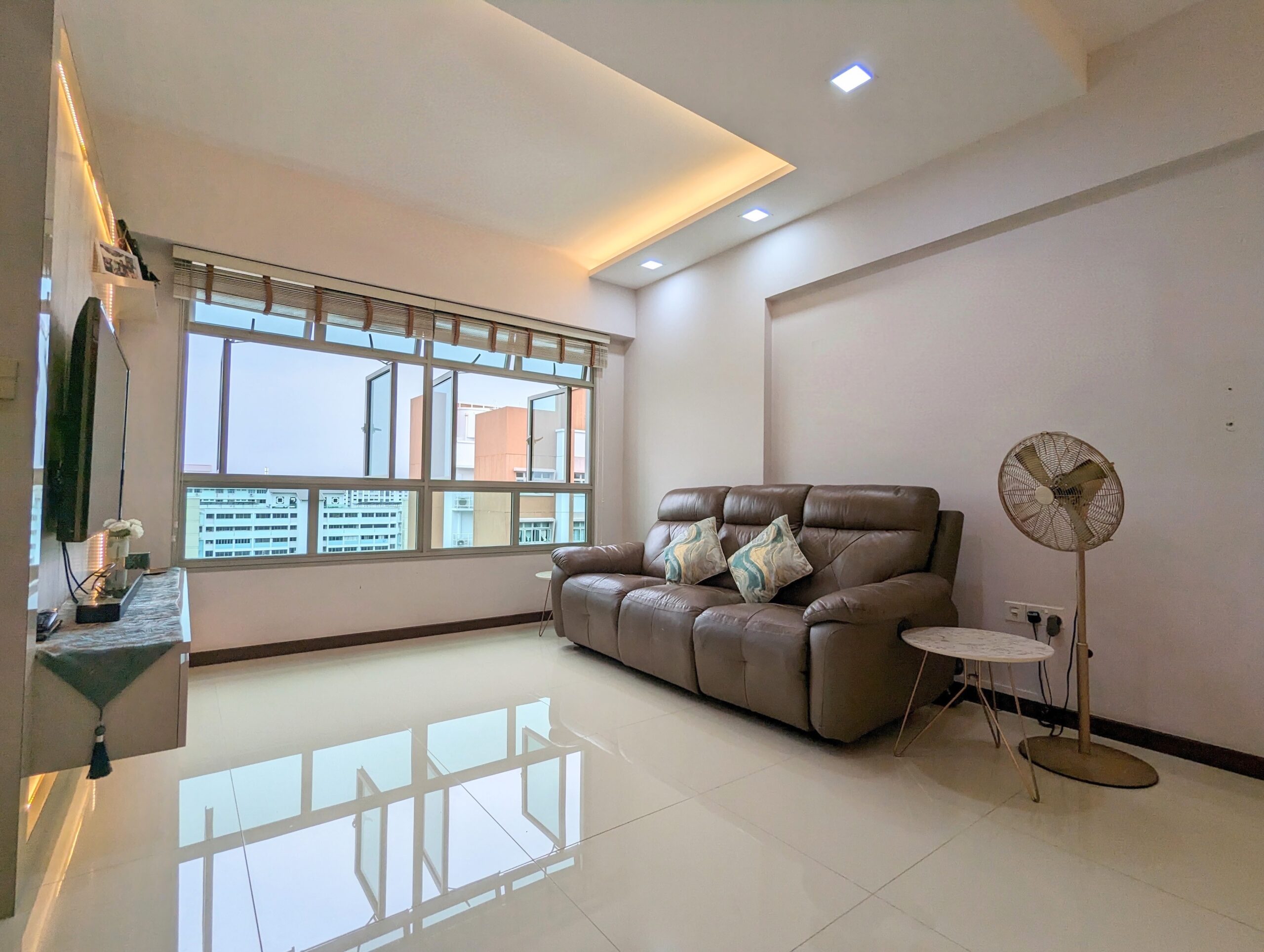
The flat they started with. Nearly paid off, and worth more than they realised.
Syaza was 35 and earned $10,000 a month. Syahir was 39, income $7,100.
Their first matrimonial home: a 4-room BTO in Tampines with just $43,000 left on the loan when my team met them.
By all accounts, they're doing great. A flat that's nearly paid up, 2 strong incomes. The next move they sought was to move to a bigger home.
For context, here's what their finances were like.
| Line | Amount |
| Sale price | $780,000 |
| Less outstanding loan | $43,000 |
| Less CPF refund, Syahir | $235,200 |
| Less CPF refund, Syaza | $139,000 |
| Gross proceeds | $362,800 |
| Less agent fee, 2% plus GST | $17,004 |
| Less legal | $3,000 |
| Cash in hand | $342,796 |
So what did they actually have to spend?
What makes this story is not just the cash proceeds they were sitting on. It's also the CPF refunds, $235,200 from Syahir and $139,000 from Syaza, and the ratio of their CPF OA funds against their individual incomes and ages. Plus the $157,800 already sitting in their Ordinary Accounts.
All of it was the war chest they could deploy into their next property, or properties.
Cash plus CPF, they were working with $874,796.
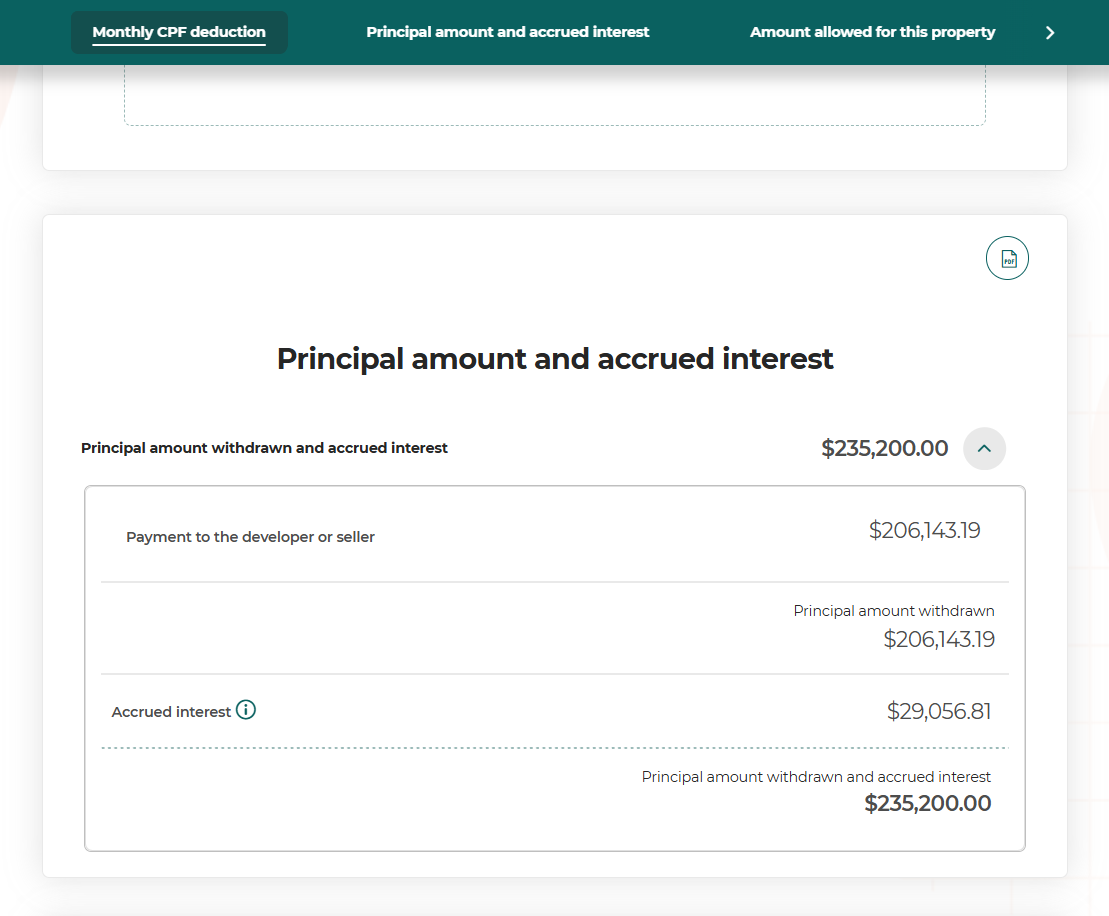
CPF used in your current property comes back to you, and can go straight into the next one.
What most people do next.
Upgraders are advised today to combine their funds and income to plan for a larger condo, possibly even a new launch if they're willing to rent for 2 to 3 years during construction.
One property. One mortgage. Two names on it.
What they did instead.
Syahir bought a resale Executive Condo in Choa Chu Kang that completed in 2018. A 2-bedder, 57 sqm (614 sqft), $885,000, in his name alone. The apartment came already rented out at $3,300 a month.
Syaza bought a 2015 Pasir Ris Grove condo for their own stay. 99 sqm (1,066 sqft), 3-bedder, bought in her name alone for $1,550,000.
So they ended up with two properties. $2,435,000 of real estate. Two separate loans, each in one name, without incurring any additional buyer's stamp duty.
Two properties, no ABSD. The interesting part is not that they did it. It is how little it cost them to do it.
Where every dollar went.
First off, they didn't use a single cent of their own savings, which they had a comfortable amount of. Everything was funded by the Tampines BTO sale proceeds.
| Line | Amount |
| Cash available from the sale | $342,796 |
| Cash used across both purchases | $265,650 |
| Cash left in the bank | $77,146 |
Syahir: 2-bedroom EC, $885,000.
| Item | Cash | CPF |
| Option fee, 1% | $8,850 | $0 |
| Exercise fee, 4% | $35,400 | $0 |
| Balance downpayment, 20% | $0 | $177,000 |
| Buyer's Stamp Duty | $0 | $21,150 |
| Legal | $0 | $3,000 |
| Total | $44,250 | $201,150 |
| Bank loan, 75% | – | $663,750 |
Syahir earns less than his wife but has been in the workforce four years longer. That shows up in his CPF.
He had $370,000 of CPF OA in total. Worth noting: at the point of the transaction, $85,000 of it was tied up in CPF investments and he had no intention of withdrawing it until truly necessary.
He used $201,150, leaving $83,850 of liquid OA behind, and never touched the investments. They were doing well and he wasn't ready to liquidate. This is important, and we'll refer back to it later.
Syaza: premium 3-bedroom in Pasir Ris Grove, $1,550,000.
| Item | Cash | CPF |
| Option fee, 1% | $15,500 | $0 |
| Exercise fee, 4% | $62,000 | $0 |
| Balance downpayment, 22% | $143,900 (~9%) | $196,900 (~13%) |
| Buyer's Stamp Duty | $0 | $47,100 |
| Legal | $0 | $3,000 |
| Total | $221,400 | $247,000 |
| Bank loan, 73% | – | $1,131,700 |
She had $247,000 of CPF OA. She used all of it. Upon collecting the keys to their new home, she had emptied out her CPF savings.
This was all done intentionally, and it would be the single most important structure in this case study.
Why she paid more than she had to.
Syaza is allowed to borrow 75% of $1,550,000, which is $1,162,500.
But through the TDSR loan framework, her income wasn't strong enough to clear that borrowing amount. Thanks, TDSR.
What's TDSR? Total Debt Servicing Ratio caps your total monthly loan repayments at 55% of your income, and the bank assesses that at a 4% interest rate. Stress tested, not market rates. On $10,000 a month over a 29-year tenure, that framework limits her borrowing at $1,131,749.
$1,162,500 loan required, less $1,131,749 loan approved. She is $30,751 short.
So they put in an extra $30,800 of cash as additional downpayment to match the loan to $1,131,700. Her loan-to-value came in at 73% instead of 75%.
They were comfortable doing that because of how the rest of the structure worked, which is the next section.
Not sure whether your own two incomes can carry two loans? That's the first thing we'd check.
Get a Second Opinion ↗Can two salaries carry two mortgages?
Crunching this part of the breakdown will decide if your 2-condo household adventure will make or break your bank.
When they bought, in 2024, fixed rates were just over 3%. Please never return to such highs.
| 2024 | Syahir & his 2br rental | Syaza & her 3br own stay |
| Loan | $663,750 over 25 years | $1,131,700 over 29 years |
| Monthly mortgage | $3,182 | $4,934 |
| Monthly CPF into OA | $1,428 | $1,564 |
| Rent collected | $3,300 | – |
CPF Ordinary Account inflow reflects the Ordinary Wage ceiling and age-band allocation rate in force that year. In 2024 the ceiling was $6,800, so both were capped at the same $2,516 total contribution. The difference between them is age.
Syahir decided to pay his mortgage using his CPF OA in full. Zero cash top-ups involved.
You must have noticed it already. His $1,428 monthly contribution does not cover the $3,182 instalment. The gap comes out of the $83,850 of liquid OA he deliberately left behind. Remember we mentioned this earlier?
At 2024 rates that gap was $1,754 a month. Two years of it drew his balance from $83,850 down to roughly $44,000, once OA interest is credited.
Then the 2026 refinance dropped his mortgage to $2,670. His OA inflow had also risen to $1,491, because the Ordinary Wage ceiling moved past his salary in 2025 and he stopped being capped. The gap fell to $1,179 a month, which stretches what's left about three more years.
When that runs out, he liquidates the $85,000 sitting in CPFIS and buys roughly six more. He will sell them when he needs them, and not before.
Three years, then six. Nine years of runway, which is roughly what a two-property position asks of you.
So the rent he receives, $3,300 from the tenant, is his cash to spend on expenses such as Syaza's mortgage, maintenance and other fees.
Syaza's CPF OA is empty. Every month she earns $1,564 into her OA. Her mortgage is $4,934. She has to top up $3,370 in cash.
So Syahir's $3,300 rent goes straight to covering Syaza's shortfall. $3,300 in, $3,370 out. She is $70 a month short, and that $70 comes out of their pockets. $70 is manageable.
That was the design. Not a happy coincidence. It was the reason Syahir took the smaller property and Syaza took the bigger one. To maximise their lopsided CPF versus income ratios.
By 2026 they refinanced. This was when we caught up, and it inspired me to write this article and prepare a full campaign around their 2-property approach.
Rates had fallen to around 1.45% to 1.65%.
| Line | Before (2024) | After (2026) |
| Syahir mortgage | $3,182 | $2,670 |
| Syaza mortgage | $4,934 | $4,040 |
| Syaza cash needed | $3,370 | $2,360 |
| Combined saving | – | $1,406 a month |
Syaza's OA inflow rose to $1,680 as the Ordinary Wage ceiling moved to $8,000, partly offset by her moving into the 36-to-45 allocation band. Syahir's rose to $1,491 in 2025, when the ceiling cleared his salary and he stopped being capped.
Syahir's rent of $3,300 now covers Syaza's $2,360, with $940 a month left over. The household went from $70 short to $940 clear. The only thing that changed was the interest rate.
This is the flat the arithmetic was for.
What we planned for, and didn't need.
In 2024 they never assumed interest rates would fall. They planned on 3% as the baseline, with room for it to go higher. They were ready to top up in cash every month to hold two properties.
In Syahir's own words: "How can you own 2 properties and not pay cash every month, it's too good to be true."
But we live in a fortunate timeline. As I write this, the average 30-year fixed mortgage in the United States is 6.71%. The UK average two-year fix is 5.59%. Singapore fixed packages are between 1.40% and 1.80%.
That gap is not a small thing. It is roughly the difference between this structure working and this structure being impossible.
US rate: Freddie Mac Primary Mortgage Market Survey, 3 September 2026. UK: Moneyfacts, September 2026. Singapore: published bank packages, August 2026.
The initial plan was that at the end of the two-year lock-in, they would refinance Syaza's loan and stretch the tenure to bring the monthly payment down. From 29 years to 35 would have taken her instalment from $4,934 to around $4,419. Breathing room, at the cost of paying interest for longer.
By the time the lock-in expired in 2026, rates were back to levels last seen before 2022. A straight refinance did the job on its own, without extending the tenure at all.
The lesson is not that rates fell. It's that they had a plan for the version where rates didn't.
What made this work.
There are two jobs in this structure, and they need completely different things.
The own-stay property is the expensive one. It needs a big loan, and a big loan needs income. That job went to Syaza, who earns $10,000 against his $7,100.
The rental property has a different job. Its mortgage has to run on CPF alone, so that every dollar of rent is free to go somewhere else. That needs a deep Ordinary Account, not a high salary. That job went to Syahir, with $370,000 in his OA against her $247,000.
Income buys the loan. CPF carries the mortgage.
They happened to have one of each, and we matched each person to the job their own balance sheet was built for.
Run it the other way and it breaks. If Syahir had taken the $1,550,000 home, his $7,100 does not clear the loan. If Syaza had taken the rental, her CPF empties inside a year and the rent disappears into her own mortgage instead of into the household.
Change the split, and it stops working.
Same household, same $17,100 a month.
$14,000 and $3,100. The $3,100 earner qualifies for roughly $360,000, which buys about $480,000 of property. There is very little worth holding at that price, and the second leg collapses.
$8,550 and $8,550. Perfectly even, and it still fails. Neither of them clears the loan on a $1,550,000 home alone. Buying it would mean pouring in cash and CPF until there is nothing left for the second property.
Look at the two of them side by side.
Syaza's Ordinary Account is at zero. She has a $4,040 mortgage and $1,680 a month going in. If her income stops, that account is empty within weeks.
Syahir has nine years sitting behind his. If his income stops, nothing happens for the better part of a decade.
That's survivable in one household because his rent covers her shortfall. It would not be survivable if they had both bought like Syaza.
One caveat on his side. $85,000 of that runway is invested, so it will be worth whatever it is worth when he needs it. It's a reserve, not a guarantee. Which is exactly why the $77,146 stayed in cash.
It won't work if.
The no-go cases.
Severely lopsided incomes.
Syaza and Syahir were 59/41 and that worked. $14,000 and $3,100 would not. Somewhere around a 70/30 split, the lower earner stops qualifying for a loan large enough to buy anything worth holding, and the second leg collapses. Run the TDSR numbers on the lower income before anything else.
Thin CPF.
If neither of you has meaningful Ordinary Account balances, both mortgages come out of cash from month one, and there is no rent big enough to bridge that.
No buffer left after completion.
One empty account in a household is survivable if the other one is deep. Two empty accounts is not.
A short horizon.
Two properties is an eight to ten year position, minimum. Selling either one inside four years now triggers Seller's Stamp Duty of up to 16%. If you might need the money back in three years, do not do this.
What they bought, and why it matters.
The restructure was only half the decision. The other half is what property number two should be.
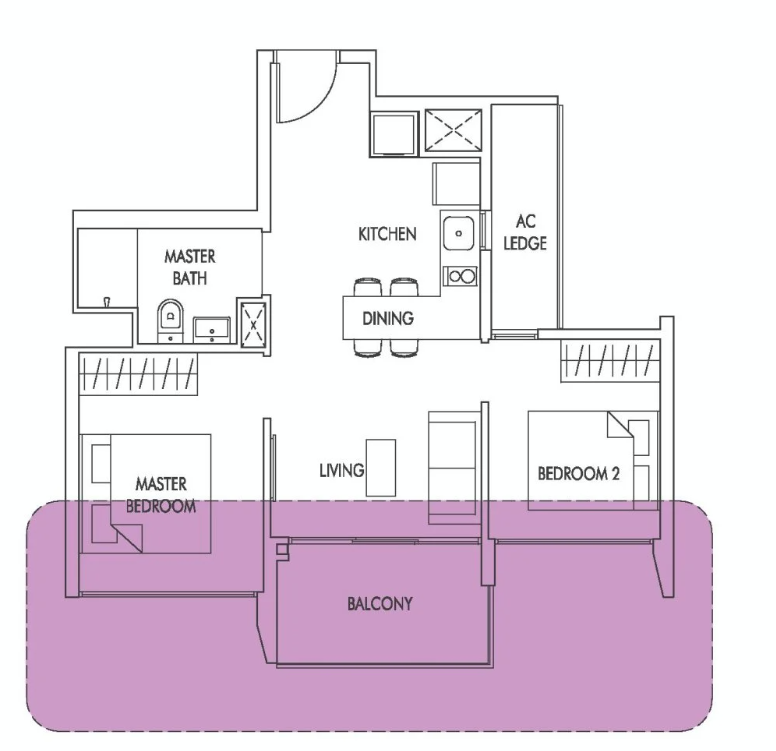
57 sqm (614 sqft), two bedrooms, one bath. Small enough to be affordable, big enough that a couple will take it. That's the entire brief for a rental unit.
Syahir bought at $885,000 and had a tenant paying $3,300 from the start. That rent is crucial.
Without a tenant from day one, there is nothing covering Syaza's shortfall, and the household is $2,360 a month down instead of $940 a month up.
To help you understand why I got them to buy an older resale condo instead of a brand new one, my team did another piece of research recently.
We looked at what actually happened to 24 condos and ECs bought around a million dollars between 2018 and 2019 and sold in 2024. The median resale returned $436,171 after all expenses. The median new launch returned $173,011.
What we discovered was that it's not about buying old versus buying new. It was about how long you could collect rent versus how long you spent waiting for construction. Resale properties were tenanted for a median of 63 months. The new launches, just 13 months in roughly 5 years.
The return gap tracks the tenancy gap, not the age of the building.
The full table, every project named, with the methodology and cost assumptions, is in the study.
Read the study In 2019, two condos sold for the same price: one resale, one new launch. Six years later: $383,812 apart. Was it the new launch? ↗Before you get excited.
This worked for Syahir and Syaza. It is not going to work for everybody.
What decides it is your CPF strength, your current loan balances, what your BTO is worth today, how your incomes are split, and your ages. Five variables, and they all affect the upgrading options you can explore.
Work with someone knowledgeable on this. That part takes a sitting and about an hour of arithmetic.
Not sure your upgrade is safe?
Tell me your situation. I'll tell you honestly if the numbers make sense before you commit to anything.
Get a Second Opinion ↗Written by
Associate Group District Director, PropNex Realty · CEA Reg No. R016820G · Leading the HeroHomes team of over 60 agents.
17 years advising HDB upgraders. Every structure I recommend to clients, I ran on my own money first. I plan the worst case before anything else.
Heikal Shafrudin, PropNex Realty, CEA R016820G.
Client names and identifying details changed with permission. All figures are from the actual transaction. CPF Ordinary Account inflows reflect the Ordinary Wage ceiling and age-band allocation rates in force in each year shown. Projected CPF runway assumes current contribution rates and mortgage instalments continue unchanged, and does not account for salary growth or changes in CPF policy. Past transactions are not an indication of future performance. ABSD, BSD, SSD, TDSR and LTV rules are as at August 2026 and subject to change. Transaction data is drawn from URA caveats and HDB resale records. Nothing here is a forecast of prices or market direction.